







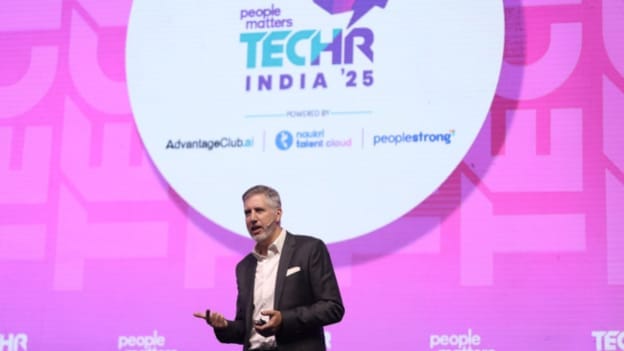
Navigating shifts driven by AI, skills evolution, organisational shifts, or culture is a complex task for HR. And no, they cannot copy-paste strategies because of factors like business size, geography, and work models.
But what can HR do to navigate these shifts successfully? Andy Weiss, a Chief Marketing Officer at Ceipal, shared six frameworks to approach challenges like tax policies, hiring, talent retention, navigating layoffs, or integrating AI.
“Organizations across the world are undergoing some or the other kind of change, be it restructuring, adopting/adapting AI in the workflow, or policy changes. This world is fluid, and it’s tough, especially in HR, as they are the ones managing flux, leading through change, figuring out how to responsibly bring AI into organizations,” commented Weiss at People Matters TechHR Conference 2025.
He further added that designing a culture, which should otherwise be simple, is not easy. Why? Different people and perspectives. “There’s always a virtual suggestion box open, with plenty of opinions,” he said.
And the temptation is to look for quick-fix answers, as the market is full of ‘best practices.’ But today’s problems cannot be solved with a one-click download. For effective strategies, context matters, because an organization’s culture is shaped by its geography, its workforce, and other dynamics. Playbooks offer certainties, but given the speed of change happening today—including market shifts and leadership changes—the original context changes too.
What works? Leaders like Warren Buffett and Charlie Munger used mental models, frameworks that don’t change, to understand how organizations create value and how they respond to market forces.
“HR too has similar enduring fundamentals. The trick is to anchor in those frameworks while adapting to whatever change comes your way, be it AI, new policies, or shifting workforce models,” Weiss pointed out.
How can HR leaders use mental models and frameworks?
“To unpack complexity, make better decisions, and lead through constant change, HR needs frameworks that aren’t rigid, but more like Lego blocks. You can stack them, combine them in different ways, break them apart, and rebuild. Frameworks that are flexible and powerful,” Weiss shared.
Six agile frameworks or mental models for HRs
#1 First principles thinking
What looks like overnight successes such as Uber or Airbnb or Liquid Death, in reality, started with a simple problem. This is due to first principles thinking at work: strip down the problem, rebuild from the ground up, but smarter.
#2 Inversion
Inversing the way you deal with situations—for example, instead of asking, “How do we win?” ask, “How do we make sure we don’t lose?”
#3 Surveys
“Running countless surveys across focus groups, and even with the best design? The reality is, people will tell you what they think you want to hear,” Weiss pointed out.
#4 Data
Data can tell a real story, like a simple principle called Occam’s Razor underlines: ‘the simplest solution is often the best.’
#5 The paradox of choice
“Too many options actually make decisions harder,” Weiss remarked.
Instead of juggling uncountable choices, choose a handful that matter most.
#6 Second-order thinking
Not just solving the immediate problem, but preparing for what happens next.
The second-order effect implies that instead of going for an immediate fix for simple problems, opt for a solution that doesn’t create further problems.
The bottom line is, HR leaders are navigating complex shifts, and in the run, they need to ensure that they aren’t chasing quick fixes or rigid playbooks, but agile frameworks or mental models that slow things down, unpack the complexity, so they make better choices.