







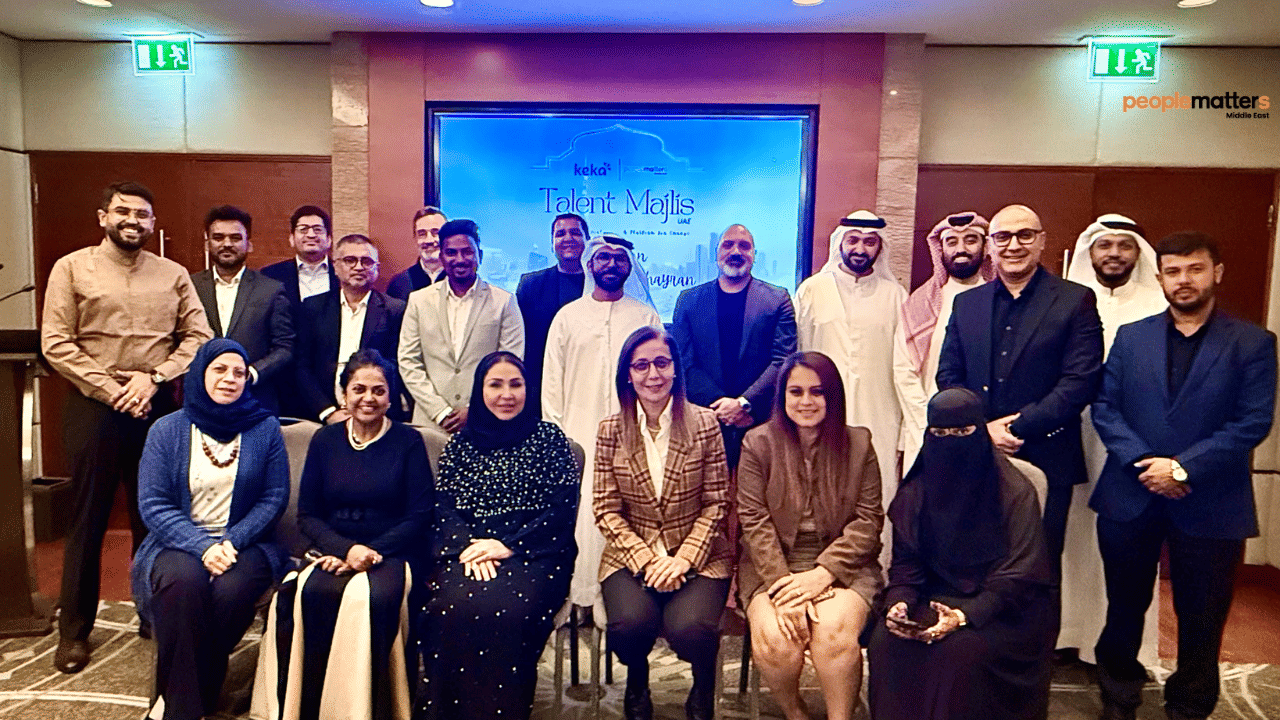
There are evenings that end when the lights go off and then there are evenings that linger, because something meaningful has shifted in the room.
The Talent Majlis, hosted in Dubai by People Matters Middle East in partnership with Keka, firmly belonged to the latter.
After powerful conversations in Oman and Kuwait, the Majlis arrived in the UAE with a clear intent: to move the dialogue on Digital HR Readiness beyond systems, dashboards, and buzzwords and into leadership intent, national alignment, and human outcomes.
The evening began not with slides or statements, but with an ice-breaking ritual aptly titled “Break Open the Cocoon.” Introduced by Aditya Chopra, who heads the Middle East region at People Matters, the activity invited leaders to shed titles and talk about what truly excites them about the work they do.
What followed was quietly powerful. Leaders spoke not just about organisational pride, but about purpose and about serving something larger than themselves. A strong thread of national alignment emerged, reflecting the UAE’s unique ecosystem where organisational ambition and community good are deeply intertwined. It was a reminder that HR leadership here is as much about nation building as it is about enterprise building.
The conversation then shifted to perspective. Praveen Seelam, Regional Head at Keka, shared Keka’s journey, from its early days to becoming a global HR technology platform serving 12,000+ companies across 150+ countries, touching the lives of 3.5 million employees in just 15 years. But what truly resonated was not the scale, it was the belief behind it: “HR systems should not just automate, but elevate,” Praveen shared.
That single line stayed with the room. Because it articulated what many leaders were feeling but hadn’t quite named: that the next chapter of Digital HR is not about efficiency alone. It is about experience, trust, and human potential.
As the discussion flowed into its core, Aditya reframed the conversation with refreshing clarity that this was not a debate on whether the UAE is digitally mature. Most organisations in the room already are. Many have moved well beyond first-wave transformation. The real question, he posed, was sharper and more consequential:
Are we leveraging Digital HR to shape workforce outcomes or merely to optimise processes?
Is Digital HR embedded into business and national planning, or still largely owned by HR teams?
And have leaders made workforce readiness an organisation- wide priority, not a functional one?
This shifted the room. A simple rating exercise (1–5) on how effectively Digital HR is being leveraged sparked an unexpectedly deep and honest dialogue. Leaders didn’t just rate themselves- they explained why. Challenges surfaced candidly. Gaps were acknowledged without defensiveness.
And that honesty itself became a marker of maturity.
The Majlis then ventured into territory that was both timely and uncomfortable, especially in the UAE context:
AI adoption in global organisations is far more complex than tools and pilots suggest.
AI must coexist with HI- Human Intelligence- if organisations are to remain sustainable.
The question isn’t whether AI will take jobs, but what kind of jobs leaders are intentionally redesigning.
Digital maturity varies sharply by organisation size, sector, and leadership mindset.
Do we truly understand the difference between AI and automation- or are they being used interchangeably?
Is AI adoption a passing trend, or is it rooted in a clearly articulated organisational need?
And perhaps most provocatively: Do leaders and generations at work even perceive AI in the same way?
These weren’t theoretical debates. They were grounded, contextual, and at times controversial, exactly what the Majlis was designed for.
As the evening progressed, a few truths crystallised clearly:
Self- awareness precedes progress: Knowing where you truly stand is the first step toward meaningful maturity.
Technology without intent plateaus quickly: The differentiator is leadership clarity, not tool sophistication.
AI demands responsibility, not urgency alone: Speed without ethics and human context is a risk, not an advantage.
Digital HR is now a national enabler: Its role in skills, productivity, Emiratisation, and trust is undeniable.
Community matters more than ever: No organisation can navigate this shift in isolation.
The conclusion was anything but ceremonial. Through a live Mentimeter activity, leaders reflected collectively- sometimes seriously, sometimes humorously- on the path ahead. Consensus emerged: AI adoption must be taken more seriously, and more responsibly.
The final exercise brought it home. In a Red- Orange- Green reflection, leaders committed to:
Start (Green): Engaging more intentionally with peers and the ecosystem.
Continue (Orange): Investing in digital capability with clearer human outcomes.
Stop (Red): Treating AI and Digital HR as check- the- box initiatives.
One sentiment stood above all others: The only way forward is together.
As the evening transitioned into a warm dinner and deeper conversations, both Praveen and Aditya beautifully summarised the journey of the Majlis, expressing gratitude to every leader who chose to show up, speak honestly, and contribute generously.
The UAE Talent Majlis didn’t end that night. It simply opened the next chapter, one where Digital HR is no longer about readiness alone, but about responsible leadership, collective progress, and a shared future.