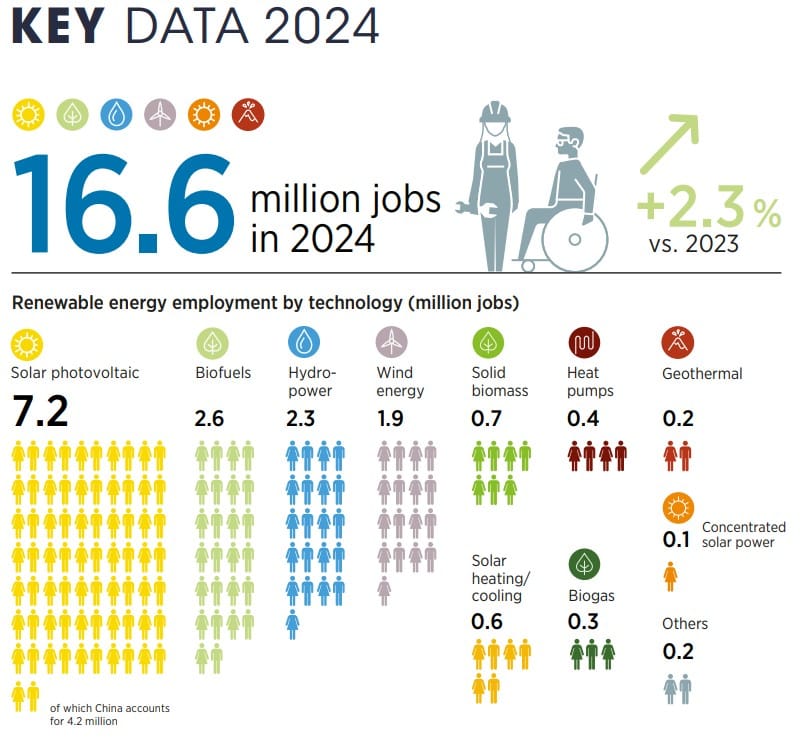
Global renewable energy employment reached 16.6 million jobs in 2024, growing just 2.3% from 2023, despite installations hitting a new peak, according to a latest report by the International Renewable Energy Agency (IRENA) and the International Labour Organization (ILO).
The
report titled, 'Renewable Energy and Jobs - Annual Review 2025,' warns that geopolitical frictions, geoeconomic pressures, and rising automation are reshaping the renewable workforce, slowing job expansion even as capacity soars.
China dominates global renewable workforce
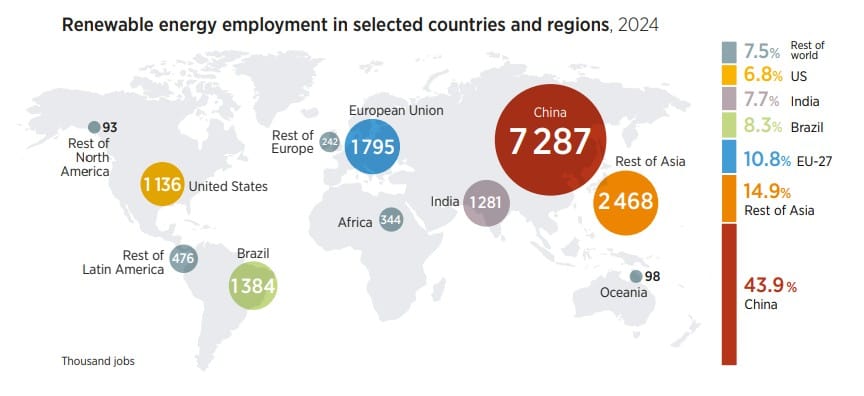
As in previous years, renewable job growth remains uneven across regions. China accounted for 44% of the world’s renewable energy jobs, generating 7.3 million positions in 2024, driven largely by its extensive, cost-competitive supply chains.
The European Union (EU) maintained 1.8 million jobs, unchanged from last year. Brazil recorded 1.4 million, while India and the United States saw marginal increases to 1.3 million and 1.1 million, respectively.
“Renewable energy deployment is booming, but the human side of the story is as important as the technological side,” said IRENA Director-General Francesco La Camera, urging governments to prioritise workforce development, domestic capability building, and international cooperation. He stressed that countries lagging in the transition must be supported to meet the global goal of tripling renewable capacity by 2030.
Solar leads, but inclusion gaps remain
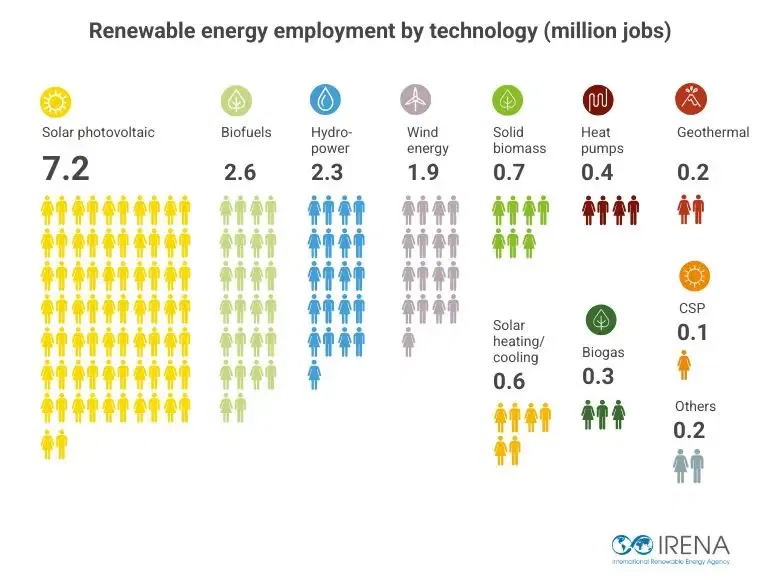
Solar PV remains the largest employer, providing 7.3 million jobs, with Asia hosting 75% of them and China alone accounting for 4.2 million.
It is followed by:
- Liquid biofuels: 2.6 million jobs
- Hydropower: 2.3 million
- Wind energy: 1.9 million
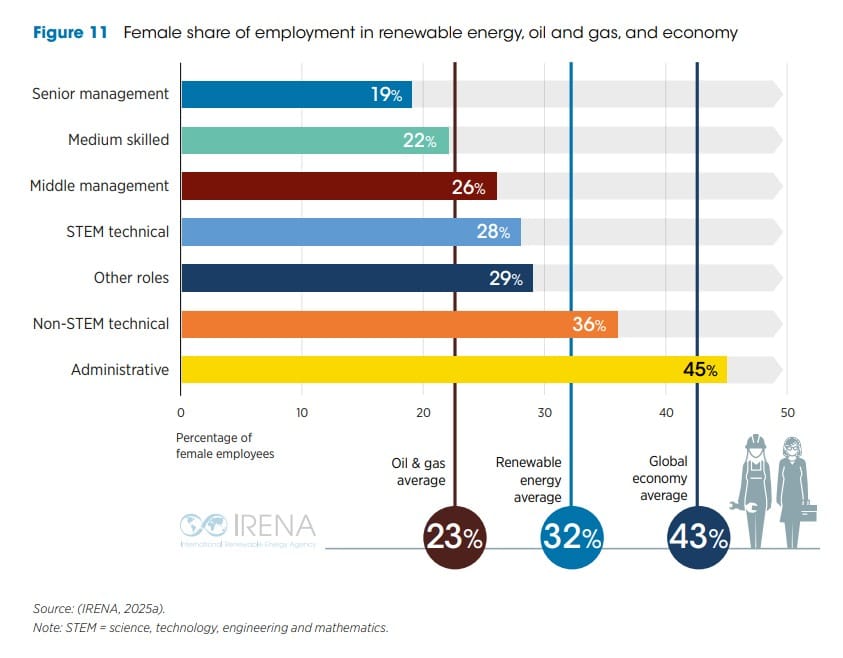
Beyond the numbers, the report shines a spotlight on inclusion and equity gaps, particularly for women and people with disabilities, whose participation remains significantly underutilised.
ILO Director-General Gilbert F. Houngbo emphasized that a just transition must ensure inclusion, dignity, and equal opportunity, calling for accessible training, inclusive hiring practices, and workplaces that accommodate diverse needs. “Disability inclusion is not only a matter of justice; it is essential for resilient labour markets and sustainable development,” he said.
Policy push needed for a truly ‘just transition’
The review calls for long-term, inclusive policy frameworks, equitable labour systems, and cultural shifts to dismantle discriminatory norms and ensure the transition benefits all communities.
Some suggested measures to make the sector inclusive for all are:
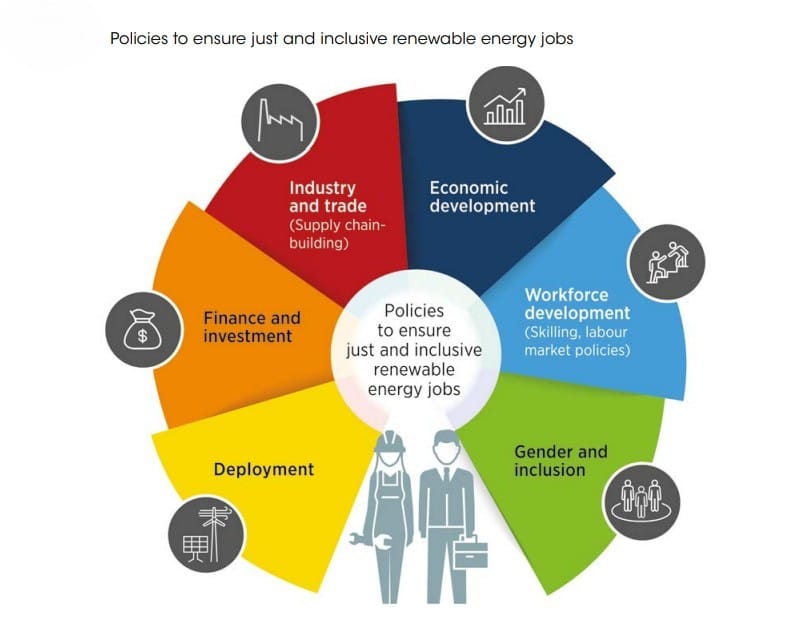
Government support:
Enforce non-discrimination laws and ensure equal pay.
Provide equitable access to education, finance, and land.
Embed gender equality in climate policies with measurable actions.
Raise awareness and protect marginalized groups, including women, indigenous communities, LGBTIQ+ individuals, and people with disabilities.
Employer and HR practices:
Offer flexible work arrangements, parental leave, and childcare support.
Create safe workplaces with zero-tolerance harassment policies and accessible reporting mechanisms.
Ensure fair recruitment, pay, and promotion practices.
Support mentorship, sponsorship, and leadership programs for women in technical and leadership roles.
Societal role:
Break cultural and systemic barriers through civil society organizations, women’s networks, and grassroots movements.
Promote STEM education for girls, scholarships, mentorship, and skill-building initiatives.
Campaign for shared domestic responsibilities and celebrate women leaders to shift societal norms.
Inclusion for people with disabilities:
Address low employment rates and wage gaps.
Design green jobs from the outset to accommodate diverse abilities in solar, recycling, environmental monitoring, and technical roles.
Provide accessible training, reskilling, and digital platforms for inclusive participation.
Include disability perspectives in policy-making through social dialogue with representative organizations.
Standards & frameworks:
Apply international labor standards for gender equality (e.g., Equal Remuneration, Violence and Harassment Conventions).
Follow disability inclusion frameworks like the ILO’s Vocational Rehabilitation and Employment guidelines and the UN Convention on the Rights of Persons with Disabilities.
Ensure policies create fair, safe, and inclusive workplaces where all employees can thrive.
The report underlines a key message that while renewable capacity is accelerating globally, the future of the energy transition will depend not only on technology, but on people, and who gets included in the workforce of tomorrow.