






Economy Policy
UAE bans social media access for children under 15, introduces strict digital safety rules







Children below 15 will be barred from accessing social media platforms and their full features, marking one of the region's most comprehensive efforts to regulate children's digital engagement.
The UAE has moved to tighten protections for young internet users, announcing a landmark decision that will prohibit children under the age of 15 from accessing social media platforms and impose stricter controls on teenagers' online activity.
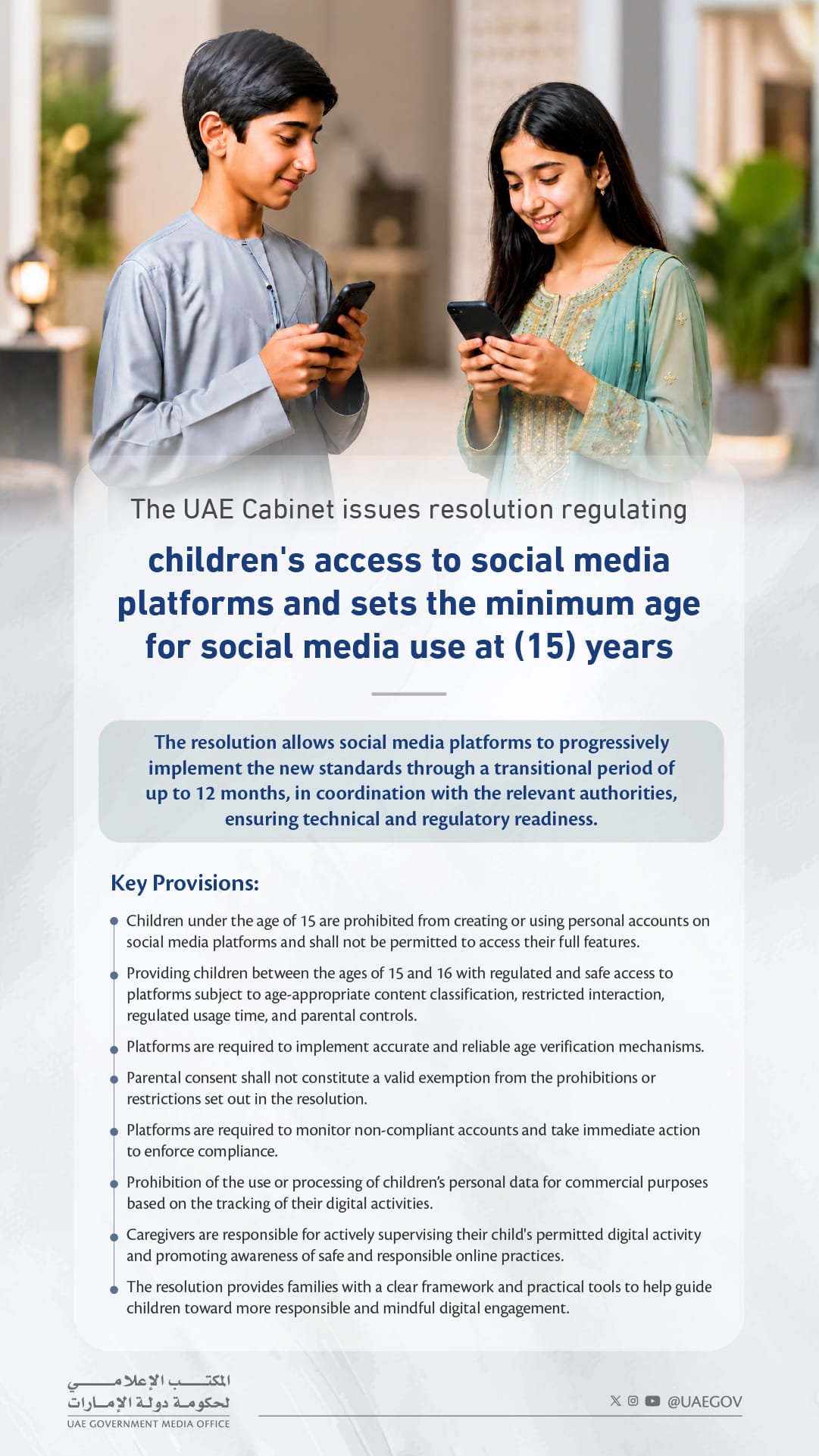
The new resolution, approved by the UAE Cabinet, sets 15 as the minimum age for creating or using personal social media accounts. Children below that age will be barred from accessing social media platforms and their full features, marking one of the region's most comprehensive efforts to regulate children's digital engagement.
Under the new framework, teenagers aged 15 and 16 will still be allowed to use social media, but only under enhanced safeguards. Platforms will be required to provide age-appropriate content classification, restrict potentially harmful interactions, regulate screen time, disable high-risk features, and offer parental control tools designed to improve online safety.
The decision reflects growing concerns over the impact of social media on children's mental health, learning outcomes, and overall wellbeing. According to a 2024 survey, children in the UAE spend approximately three hours per day on social media platforms. Health and education experts have increasingly warned that excessive screen time can contribute to anxiety, attention difficulties, academic performance issues, and, in some cases, developmental and speech-related challenges.
A key feature of the resolution is its requirement for social media companies to introduce robust age-verification systems capable of accurately determining users' ages. Platforms must also actively monitor accounts that violate the new rules and take immediate corrective action to ensure compliance.
The regulations go further than many existing parental-consent models by explicitly stating that parental approval cannot be used to bypass age restrictions. Even if a parent permits a child to create an account, that consent will not override the legal requirements established by the resolution.
In a significant move aimed at protecting children's privacy, the Cabinet has also prohibited the collection and commercial use of children's personal data based on tracking their digital activities. The measure seeks to prevent companies from leveraging children's online behaviour for advertising, profiling, or other commercial purposes.
While the regulations place new responsibilities on technology companies, they also assign a greater role to parents and caregivers. Families will be expected to actively supervise their children's online activities and promote awareness of safe and responsible internet use. Officials said the framework is intended to provide parents with practical tools and clearer guidance for managing children's digital habits.
Social media companies will be granted a transitional period of up to 12 months to implement the new requirements in coordination with relevant authorities. The phased approach is designed to allow platforms sufficient time to establish the necessary technical systems and compliance mechanisms.
The UAE joins a growing number of countries seeking to limit children's exposure to social media. Governments in countries such as the United Kingdom, Australia, and Malaysia have introduced or proposed measures aimed at restricting access for younger users amid mounting evidence linking excessive social media use to mental health concerns and addictive behavioural patterns.
Experts have long argued that social media platforms are engineered to encourage repeated engagement through features such as likes, shares, comments, and notifications. These interactions stimulate dopamine release in the brain's reward system, creating reinforcement loops that can encourage prolonged usage, particularly among younger users.
The UAE's latest move signals a broader shift in how governments are approaching child safety online, placing greater accountability on technology platforms while recognising the growing influence digital environments have on children's development and wellbeing.
Author
Loading...