






Leadership
Global CEO exits jump 21% above eight-year average as boards reset expectations







Women represented nearly 9% of departing CEOs, up sharply from 5% in 2024, while the share of incoming women CEOs fell from a record 15% to roughly 8%.
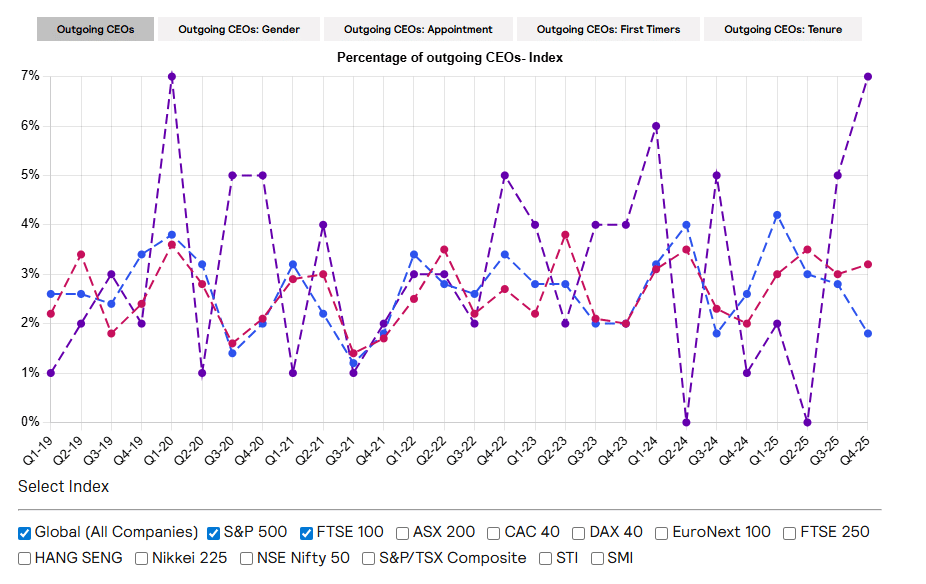
Global CEO turnover reached an all-time high in 2025, underscoring how dramatically the top job has changed as boards confront economic volatility, investor activism, and accelerating transformation pressures.
According to the latest Global CEO Turnover Index from Russell Reynolds Associates (RRA), 234 chief executives exited their roles worldwide in 2025, up 16% from 2024 and 21% above the eight-year average. It marked the second consecutive year of record-breaking CEO departures.
“Elevated CEO turnover is now a fixed feature of today’s governance environment,” the report said, pointing to a leadership landscape where expectations are rising and patience is shrinking.
Asia and Europe drive the surge
While CEO turnover remained high but stable in major Western markets, the global increase was largely driven by sharp year-over-year spikes across Asia Pacific and parts of continental Europe.
Germany’s DAX saw eight CEO departures in 2025, up from just three the year before. India’s NIFTY 50 more than doubled its exits, rising from three to seven, while Singapore’s STI recorded five departures, compared with three in 2024.
In contrast, turnover in the S&P 500 edged up only marginally, with 59 CEO exits in 2025, one more than the previous year, reflecting sustained but steady pressure from investors. The UK’s FTSE 100 also remained relatively consistent, with 14 departures, up slightly from 12 in 2024.
RRA noted that activist scrutiny continues to shape boardroom decisions, particularly in the US. Research cited in the report showed investors launched 141 activist campaigns in 2025, a 23% increase from the year before.
“The CEO role has become materially more complex and harder than it has ever been,” said Rusty O’Kelley, RRA’s Co-Lead of Board and CEO Advisory Partners in the Americas. “As investor expectations recalibrate, the margin for error has narrowed significantly.”
CEO tenures continue to compress
The rise in departures is unfolding alongside a steady shortening of CEO tenures. The average outgoing CEO served 7.1 years in 2025, down from 7.4 years in 2024 and well below the 8.3-year average recorded in both 2021 and 2023.
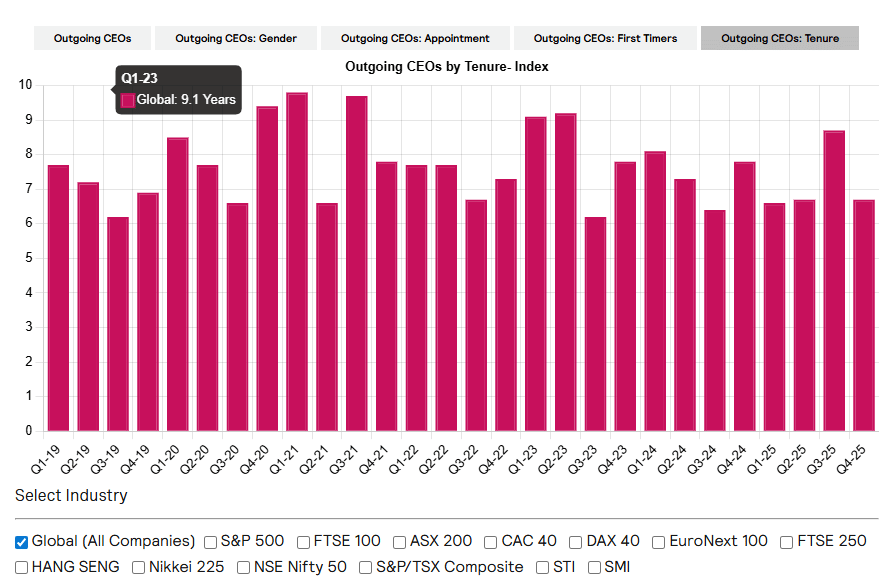
Even more striking is the growth in very short tenures. The proportion of CEOs leaving within 30 to 36 months jumped 79% year-over-year, while roles lasting less than a year accounted for about 5% of all global CEO exits.
In absolute terms, 11 CEOs stepped down within their first year, matching the highest level since RRA began tracking the data.
The compression reflects boards moving faster to judge performance and momentum in an environment shaped by rapid technological change, geopolitical risk, and constant market scrutiny.
“Historically, the first couple of years of a CEO’s tenure were about clarifying the mandate and building alignment,” said Laura Sanderson, RRA’s EMEAI Co-Lead. “That grace period has been severely compressed.”
Planned succession overtakes retirement
One of the most notable shifts in 2025 was how CEOs exited. Planned successions accounted for 32% of global departures, overtaking retirements for the first time on record.
Retirements made up 26% of exits, while board-led removals declined to 9%, down from 14% the previous year.
The trend was especially pronounced in the technology sector, where 40% of CEO exits were succession-driven, compared with just 5% in 2023.
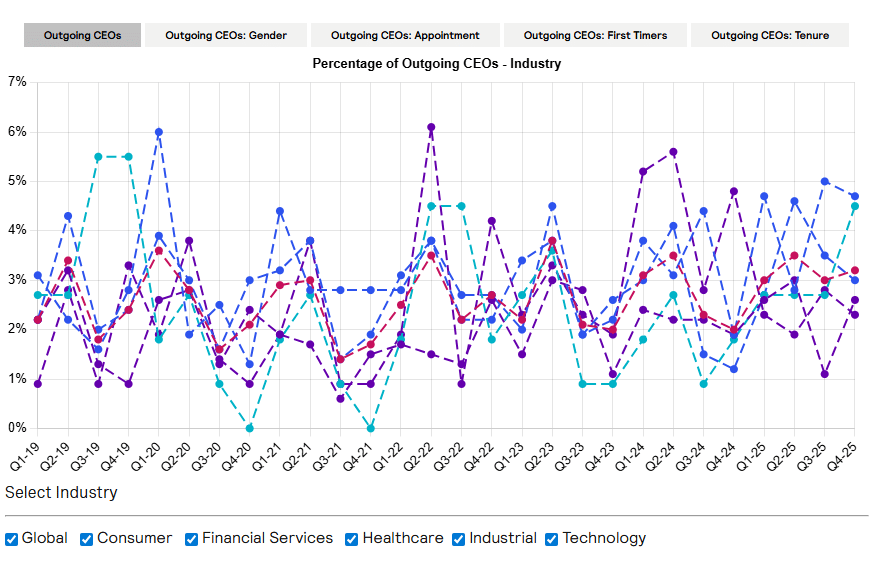
Industrial and natural resources firms, along with financial services companies, also saw a growing share of deliberate, board-led transitions.
Rather than reacting to crises or waiting for retirement, boards are increasingly using CEO succession as a strategic lever to balance continuity with renewal, RRA said.
Women CEOs face a setback
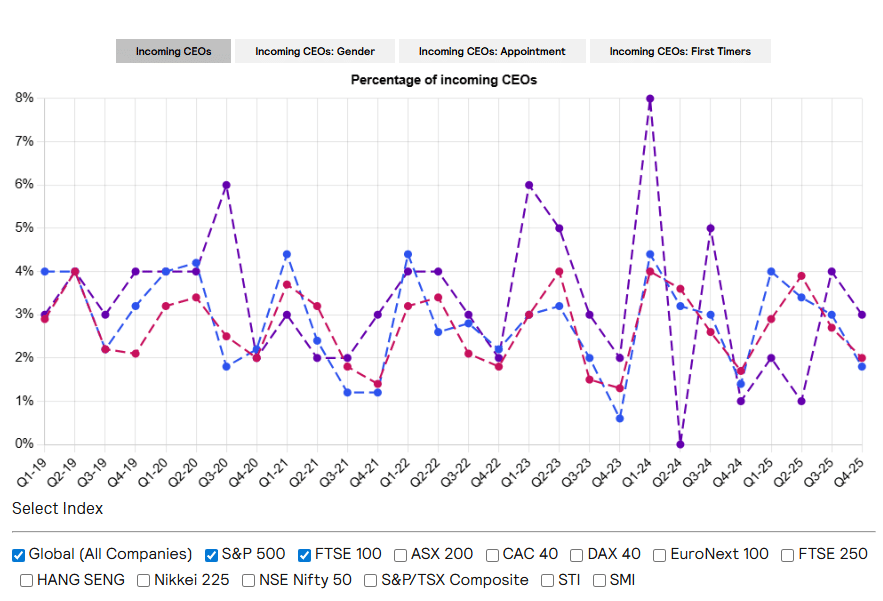
The data also highlighted a reversal in gender representation at the top. Women accounted for about 9% of incoming CEOs globally in 2025, continuing a decline from the peak seen in 2022. At the same time, the share of outgoing women CEOs rose to around 7%.
In the S&P 500, women represented nearly 9% of departing CEOs, up sharply from 5% in 2024, while the share of incoming women CEOs fell from a record 15% to roughly 8%.
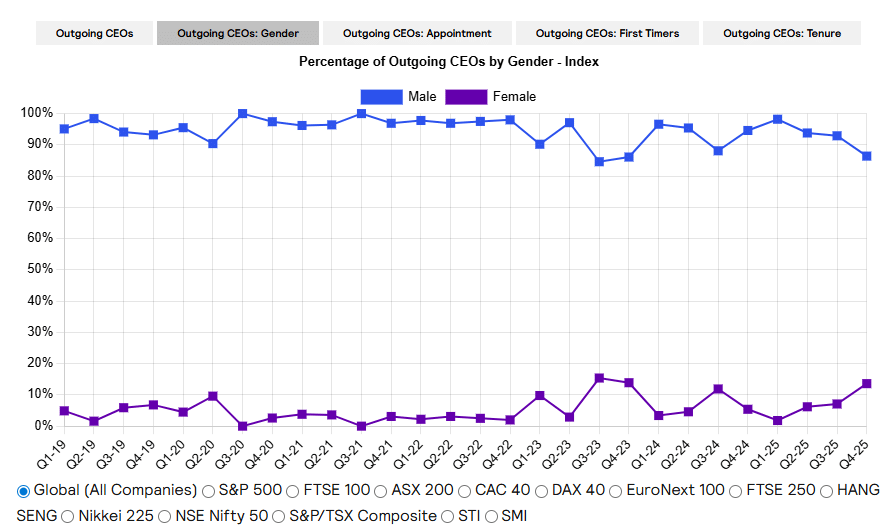
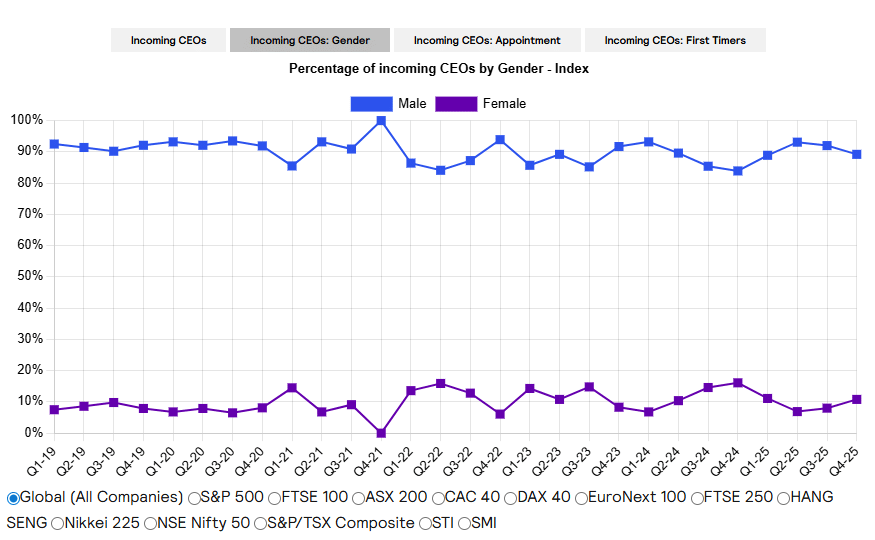
RRA warned that recent gains remain fragile, underscoring the need for sustained focus rather than episodic progress.
What it means for boards and HR leaders
With 86% of incoming CEOs globally being first-time leaders, the report argues that boards need to rethink what “CEO readiness” really means. Experience alone is no longer enough in a compressed leadership cycle.
“For first-time CEOs especially, readiness is less about having done the job before and more about learning agility, decision-making under pressure, and the ability to build and mobilize a senior team quickly,” the report said.
RRA urged boards to begin succession planning three to five years in advance, building a bench of multiple credible candidates rather than relying on a single “ready now” option. Early planning also allows boards to prepare leaders for scenarios ranging from activist pressure to sudden external shocks.
Equally important, the firm said, is treating CEO development as an ongoing governance responsibility, not a remedial one once performance falters.
As CEO lifecycles shorten and expectations accelerate, the report concludes, the leaders who succeed will be those supported by boards that plan earlier, move deliberately, and invest continuously, even after the appointment is made.
Author
Loading...