






AI & Emerging Tech
Anthropic CEO Dario Amodei rejects claims he supports surrendering human free will to AI






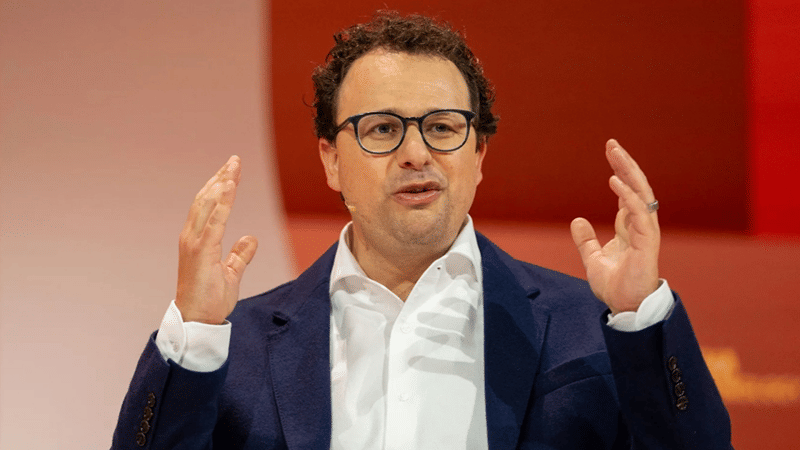
He also argued that decisions about AI automation would not necessarily rest with a single authority, but could be distributed among governments, businesses, individuals and wider society, depending on the context.
Anthropic CEO Dario Amodei has pushed back against claims that he believes humans should hand over decision-making and governance to superintelligent artificial intelligence (AI), arguing that the technology must remain subject to legitimate democratic processes.
In a lengthy post on X on Wednesday, Amodei rejected an Axios report describing a debate within the AI industry over whether humans should eventually delegate decision-making to increasingly advanced AI systems.
"No, I do not believe that we should 'surrender human free will' to AI systems, and it's absurd to suggest that I do," Amodei wrote, adding that a consistent theme across his essays has been the need for AI to be governed through democratic processes.
He argued that the pursuit of efficiency or security should not come at the expense of human autonomy, drawing parallels with historical arguments in favour of autocracy.
"For millennia (going all the way back to Greek and Roman philosophers), advocates of autocracy have claimed that it leads to better, faster, or more decisive decision-making than the messy process of democracy. Even if this were true (which I doubt!), we should never sacrifice legitimacy or self-determination at the altar of efficiency or security," he wrote.
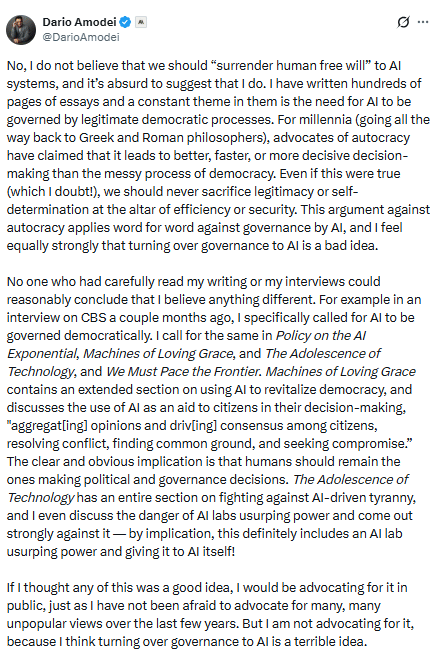
Amodei added that the argument against autocratic governance also applied to handing decision-making authority to AI, describing the idea as a bad one.
Amodei distinguishes AI governance from task automation
Amodei said the reporting conflated the idea of AI governing society with the growing ability of AI systems to automate individual tasks, including driving vehicles, designing medicines and writing software end-to-end.
He described the latter as potentially economically valuable, capable of advancing sectors such as medicine, transportation, energy and software development, and saving lives. However, he cautioned that greater autonomy also brings risks that may require restrictions, oversight or slower deployment.
One concern, he said, is recursive self-improvement (RSI), in which AI systems contribute to developing successive generations of AI. Amodei warned that this process could accelerate AI development beyond society's ability to control or adapt to it.
"We don't expect it to be safe for Claude to build successive frontier models fully autonomously, without meaningful human supervision or understanding," he said, referring to Anthropic's public position on the issue.
He also highlighted the potential for end-to-end AI automation to disrupt jobs, arguing that some deployments may need to be slowed or halted to give workers time to adapt. While AI could prove valuable in alignment research, he said such applications would also require caution because researchers may not be able to fully trust the systems' outputs.
Amodei added that people may choose to retain involvement in certain activities even when AI can perform them more efficiently, because they value the process and their own engagement.
Also read: Anthropic researcher warns superhuman AI could make humans permanently unemployable by 2027
AI decision-making will require different levels of oversight
Amodei argued that decisions about AI automation would not necessarily rest with a single authority, but could be distributed among governments, businesses, individuals and wider society, depending on the context.
He said he did not believe other AI companies fundamentally differed from Anthropic in their approach to automating specific tasks, noting that the industry was broadly developing increasingly capable systems while acknowledging the risks involved.
He also criticised what he described as commercial and political positioning around human agency, arguing that slogans about AI being merely a tool or preserving human control were not enough without meaningful action addressing the underlying risks.
The debate comes as AI companies accelerate the development of increasingly autonomous systems, bringing questions of oversight, accountability, workforce disruption and human control closer to the centre of discussions about the future of AI.
Author
Loading...