






Economy Policy
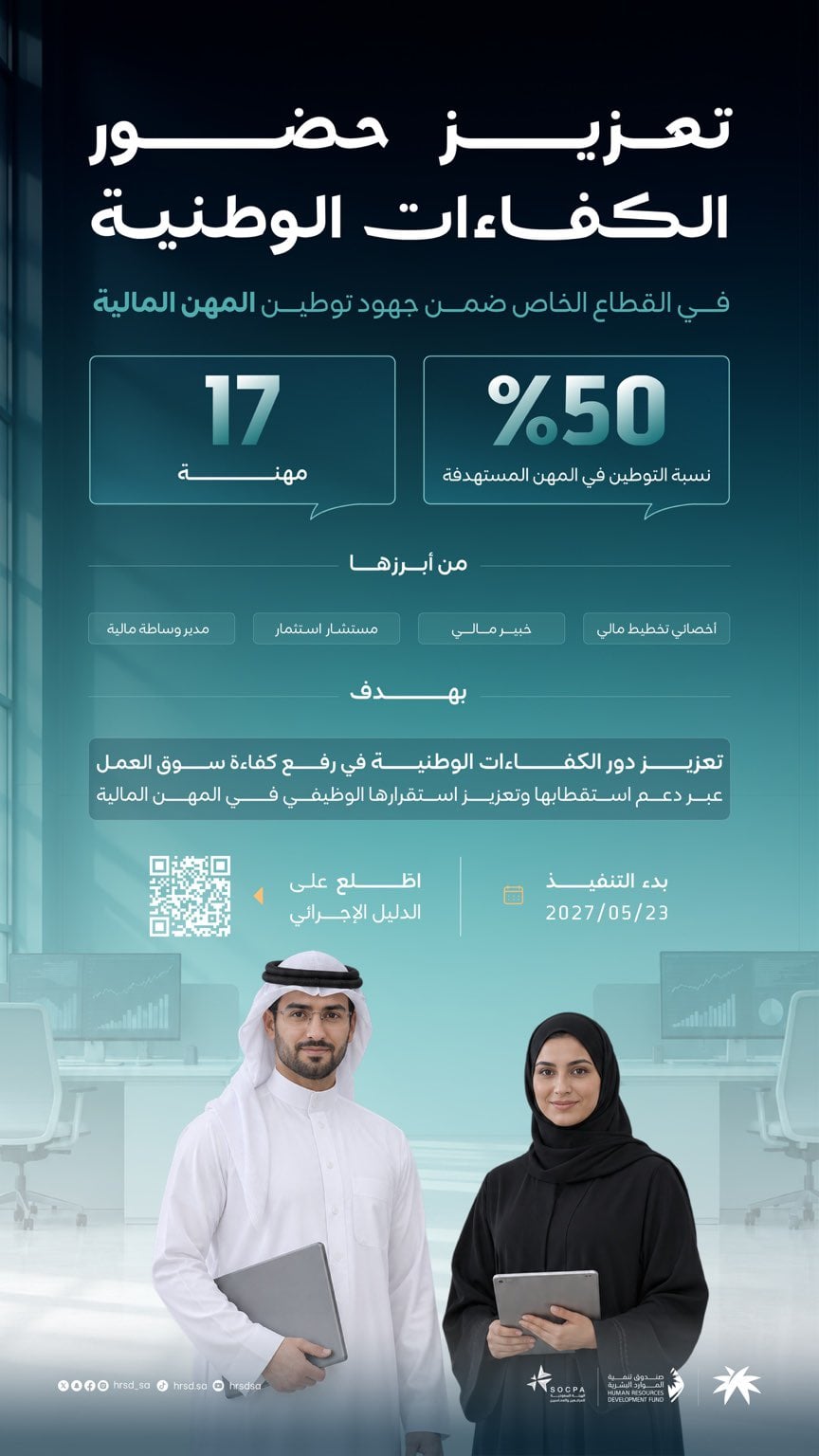
Saudi Arabia mandates 50% Saudization in 17 financial professions from May 2027







The requirement applies to private-sector establishments employing at least two workers in the designated professions.
Saudi Arabia will require private-sector establishments to ensure that at least 50% of employees across 17 designated financial professions are Saudi nationals from May 23, 2027, as the Kingdom steps up efforts to localise specialised roles.
The Ministry of Human Resources and Social Development (MHRSD) announced the decision in cooperation with the Saudi Organization for Chartered and Professional Accountants (SOCPA), aligning the measure with the Kingdom's Vision 2030 objectives to increase national workforce participation and expand employment opportunities in the private sector.
The targeted occupations include investment management, financial analysis, financial planning, treasury operations and financial advisory services. Other designated positions include credit managers, investment advisers and financial specialists involved in oversight and consultancy.
The requirement applies to private-sector establishments employing at least two workers in the designated professions.
According to the ministry's procedural guidelines, the 50% localisation threshold will be calculated collectively across the targeted occupations at the establishment level, rather than separately for each profession.
The latest measure builds on earlier Saudization initiatives, including a phased requirement introduced in October 2025 to raise Saudi employment in accounting professions to 70% by 2028 at establishments employing five or more accounting professionals.
The new requirement could intensify competition for qualified Saudi financial professionals and increase recruitment and training costs for financial institutions, particularly investment firms, asset managers and financial advisory businesses.
Aseel Al-Aranki, head of financial market analysis at CG Invest, told Arab News that demand for experienced Saudi professionals could put upward pressure on salaries in specialised occupations.
“Competition for experienced Saudi financial professionals could intensify, potentially putting upward pressure on salaries in certain specialized occupations,” Al-Aranki said.
Smaller financial institutions could also face additional pressure on operating costs and profit margins as they restructure their workforces to meet the requirements.
However, Al-Aranki said the policy could strengthen the Kingdom's financial sector over the longer term by developing domestic expertise.
“The real challenge will be ensuring that recruitment is accompanied by continuous training, professional development and the transfer of technical expertise,” she added.
Private-sector establishments will receive a six-month transition period to adjust their recruitment and workforce plans before the new requirements take effect.
The ministry said eligible employers could access recruitment assistance, professional training, qualification programmes and employment incentives. They will also receive priority access to available localisation support programmes, subject to individual eligibility requirements.
The procedural guidelines exclude establishments operating in economic activities supervised by the Capital Market Authority and the Saudi Central Bank.
The ministerial decision also stipulates that where multiple localisation requirements apply to the same occupations, employers must comply with the higher applicable percentage.
The measure adds to Saudi Arabia's broader efforts to increase the participation of nationals in specialised private-sector occupations while building a skilled domestic workforce to support the Kingdom's economic diversification plans.
Author
Loading...