






Recruitment
AI trainer boom, urban return and currency hopping signal global workforce trends: Deel report







The report reveals that top-funded startups hire internationally for expertise, not cost savings, with cross-border recruitment focused on high-income countries.
Global hiring trends are undergoing significant shifts, with artificial intelligence (AI) creating entirely new job categories, startups increasingly recruiting international talent for expertise rather than cost savings, and workers seeking financial protection through alternative payment methods.
The findings of the 2025 State of Global Hiring report released by Deel, analyses hiring data from more than one million workers across 37,000 companies in over 150 countries. It highlights four major changes reshaping the global labour market: the rise of AI trainers as a new profession, a shift in cross-border hiring strategies among startups, remote workers moving closer to urban centres again, and contractors increasingly opting for stable currencies such as the U.S. dollar or stablecoins.
AI trainers emerge as a new global profession
One of the most striking developments is the rapid emergence of AI trainers, a role that barely existed a few years ago. According to the report, more than 70,000 workers across 600 organisations are now engaged in training AI systems, performing tasks ranging from basic data annotation to highly specialised expert feedback in fields such as medicine, economics and translation.
Cross-border hiring for general AI trainer roles grew 283% in 2025, making it the fastest-growing international role on Deel’s platform.
Compensation varies widely depending on the complexity of the work. Around 30% of trainers earn between $15 and $20 per hour for annotation tasks, while 19% earn $50–$75 per hour and 6% command more than $100 per hour for specialised expertise.
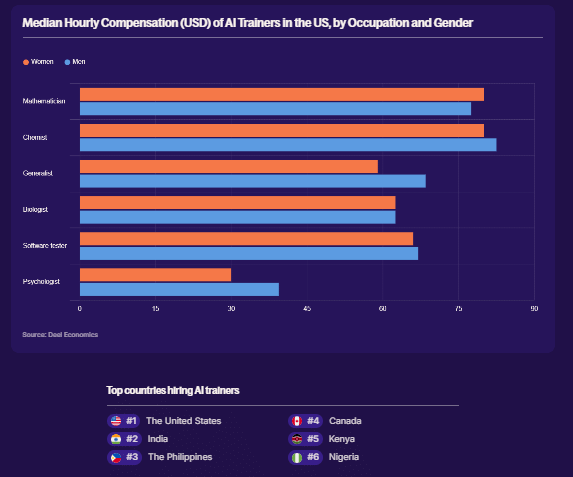
The United States accounts for 58% of AI trainers, followed by India (7.2%), the Philippines (4.6%), Canada (2.1%) and Kenya (1.7%). However, the report also highlights a persistent gender pay gap in the field. In the U.S., male AI trainers earn a median of $50 per hour, compared with $30 per hour for female trainers, largely due to differences in specialisation across roles.
Startups hire internationally for expertise
The findings also challenge the long-held assumption that companies hire internationally mainly to reduce costs. Among nearly 100 startups founded between 2020 and 2025 that raised more than $100 million in funding, cross-border hiring is concentrated in high-income countries.
The United Kingdom leads with 12.2% of hires, followed by Canada (11.9%), Germany (8.8%), Australia (5.8%) and Spain (5.2%).
Software developers account for 28% of cross-border hires among these startups, followed by tech sales (6.2%), business developers (4%) and AI engineers (2%). Overall, startups are 13.6 percentage points more likely to hire software developers internationally than small and medium-sized businesses.
The report also notes that seven of the top ten cross-border roles globally are in sales, marketing or customer-facing functions, suggesting that local market knowledge remains critical despite advances in automation.
Remote workers drifting back to cities
Another emerging pattern is what the report describes as the “urban boomerang.” After moving away from major metropolitan areas during the pandemic, many remote workers are gradually relocating closer to large cities again.
The average distance of cross-border employees from urban centres increased between 2021 and 2022, but has steadily declined each year since. In the United States, remote workers are now as close to major cities such as New York, Los Angeles, Chicago, Houston and San Francisco as they were in 2021, with similar patterns observed in London and Paris.
Leadership roles drive global salary growth
Compensation growth in 2025 was largely concentrated in senior leadership positions, although regional trends differed sharply.
In the United States, project managers recorded the highest pay growth at 24.5%, followed by chief operating officers (21.6%) and chief executives (20%).
In Latin America, however, COO salaries surged by 99.8%, nearly five times the U.S. growth rate for the same role. Financial analysts in the region saw an even sharper increase, with compensation rising 195.5%, reflecting the growing professionalisation of operational roles in emerging markets.
Currency hopping
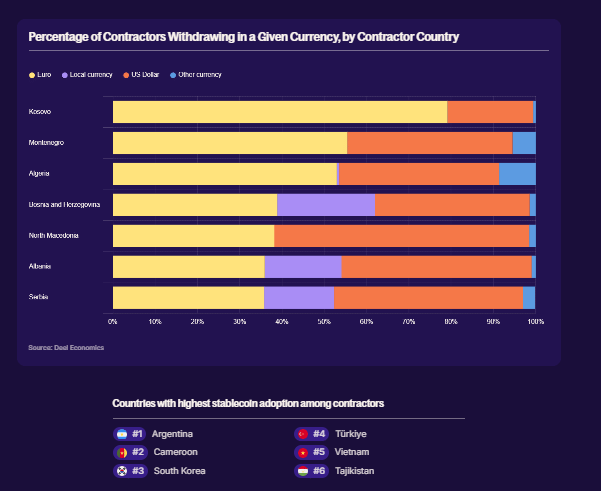
Economic instability in several markets has also prompted workers to rethink how they receive payments. The report highlights a growing trend of “currency hopping,” where contractors choose to be paid in more stable currencies to safeguard their income.
The U.S. dollar appeared in five of the ten most common payment currency combinations globally in 2025. In Argentina, more contractors chose to be paid in USD than in local pesos, while Bolivia showed a clear link between rising inflation and increased adoption of USD payments.
Argentina also leads global adoption of stablecoin payments, followed by Cameroon, South Korea, Turkey, Vietnam, Tajikistan, Sri Lanka and Ukraine.
According to Lauren Thomas, economist at Deel, the data indicates that international hiring is increasingly driven by talent competition rather than budget constraints.
“This year’s data shows that hiring internationally isn’t about shrinking budgets but about intense competition for the best talent,” she said, noting that much of that talent still clusters around major metropolitan areas.
Meanwhile, Kristine Lipscomb, general manager of global mobility at Deel, said the rise of currency hopping signals workers taking greater control over their financial mobility in a borderless labour market.
Healthcare and legal roles also surge
Beyond technology and AI, the report highlights strong growth in other sectors as well. Professional and business services is the fastest-growing industry for cross-border employees hired through employer-of-record systems, followed by government and nonprofit organisations and manufacturing.
Across all worker types, healthcare and life sciences lead industry growth, followed by real estate and construction. Among the fastest-growing cross-border roles are legal case managers (164% growth) and medical administrative assistants (123%), alongside AI trainers.
The findings underscore a broader shift in the global workforce: as technology evolves and economic uncertainty persists, both companies and workers are increasingly adapting their strategies to operate in a more global, flexible and digitally connected labour market.
Author
Loading...