






Workforce Planning
Kuwait allows temporary job transfers for foreign workers in key sectors







The policy is temporary (only two months) and meant to meet urgent workforce needs without affecting long-term job contracts or employer-employee agreements.
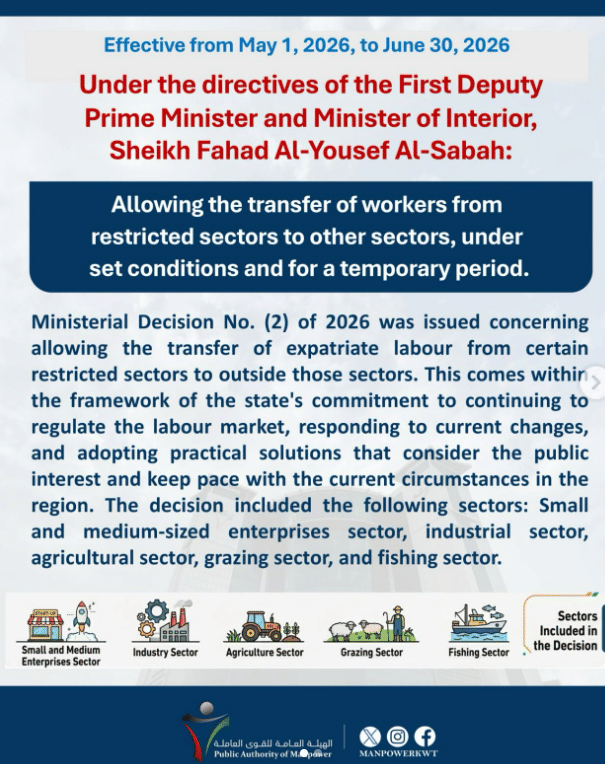
Kuwait has announced a temporary policy allowing certain foreign workers to switch jobs or move between sectors for a limited two-month period, from May 1 to June 30, 2026.
The move, issued under Ministerial Decision No. (2) of 2026 by First Deputy Prime Minister and Minister of Interior Sheikh Fahad Al-Yousef Al-Sabah, is part of broader efforts to recalibrate the country’s labour market in response to evolving economic conditions and sectoral workforce demands.
The Public Authority for Manpower (PAM) said the policy reflects a “disciplined flexibility” approach aimed at balancing market needs with employment stability, while maintaining regulatory oversight over worker mobility.
Targeted sectors under the policy The temporary transfer mechanism will apply to workers in five key restricted sectors:
Small and Medium Enterprises (SMEs) sector
Industrial sector
Agricultural sector
Grazing sector
Fishing sector
Officials said the decision is designed to ease labour imbalances in sectors facing workforce surpluses or constraints, while enabling smoother reallocation of manpower where demand is higher.
Digital-first transfer system
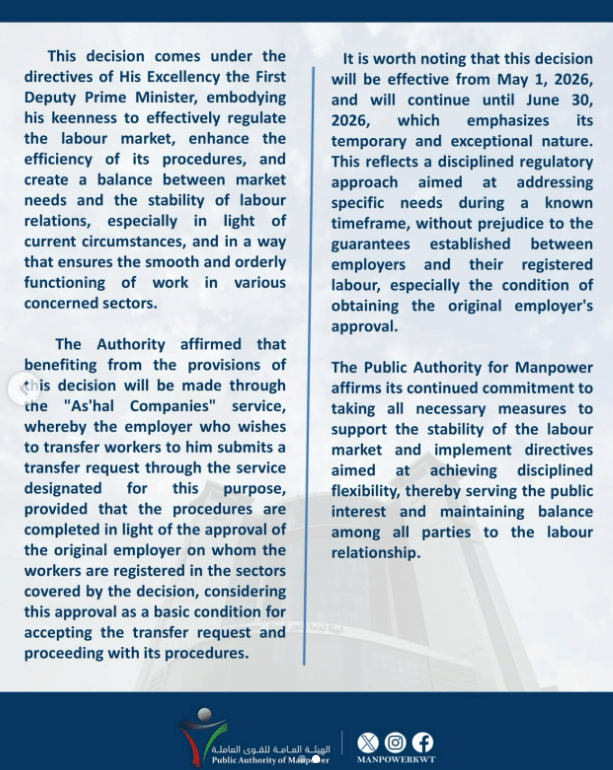
Transfers will be processed through the “As’hal Companies” service, a digital platform managed by the labour authority. Employers seeking to hire eligible workers must submit formal transfer requests through the system.
However, approval from the original employer remains a mandatory condition for any transfer to proceed, a safeguard intended to preserve contractual integrity and prevent unilateral workforce displacement.
Temporary measure with strict timeline
Authorities emphasized that the policy is strictly time-bound, running for just two months. Officials described the short duration as evidence of its “exceptional and targeted” nature, rather than a structural overhaul of labour law.
By limiting the window, the government aims to address immediate workforce requirements without disrupting longer-term employment relationships or contractual protections between employers and expatriate workers.
Balancing flexibility and stability
The Public Authority for Manpower said the initiative reflects ongoing efforts to enhance efficiency in labour market operations while maintaining stability across sectors.
It added that the framework seeks to ensure “orderly functioning of work environments” and preserve balance between employers’ operational needs and workers’ rights within the regulatory system.
As Kuwait continues to adjust its labour policies amid regional economic shifts, the temporary transfer window signals a calibrated attempt to introduce flexibility without loosening oversight, a balancing act that has become central to workforce reform strategies across the Gulf.
Topics
Author
Loading...