






Strategic HR
Oman Labour Ministry outlines new rules for remote work; Says return-to-office is employer’s right







The Labour Ministry has defined employees’ right to disconnect from work and employers’ right to enforce return-to-office policies.
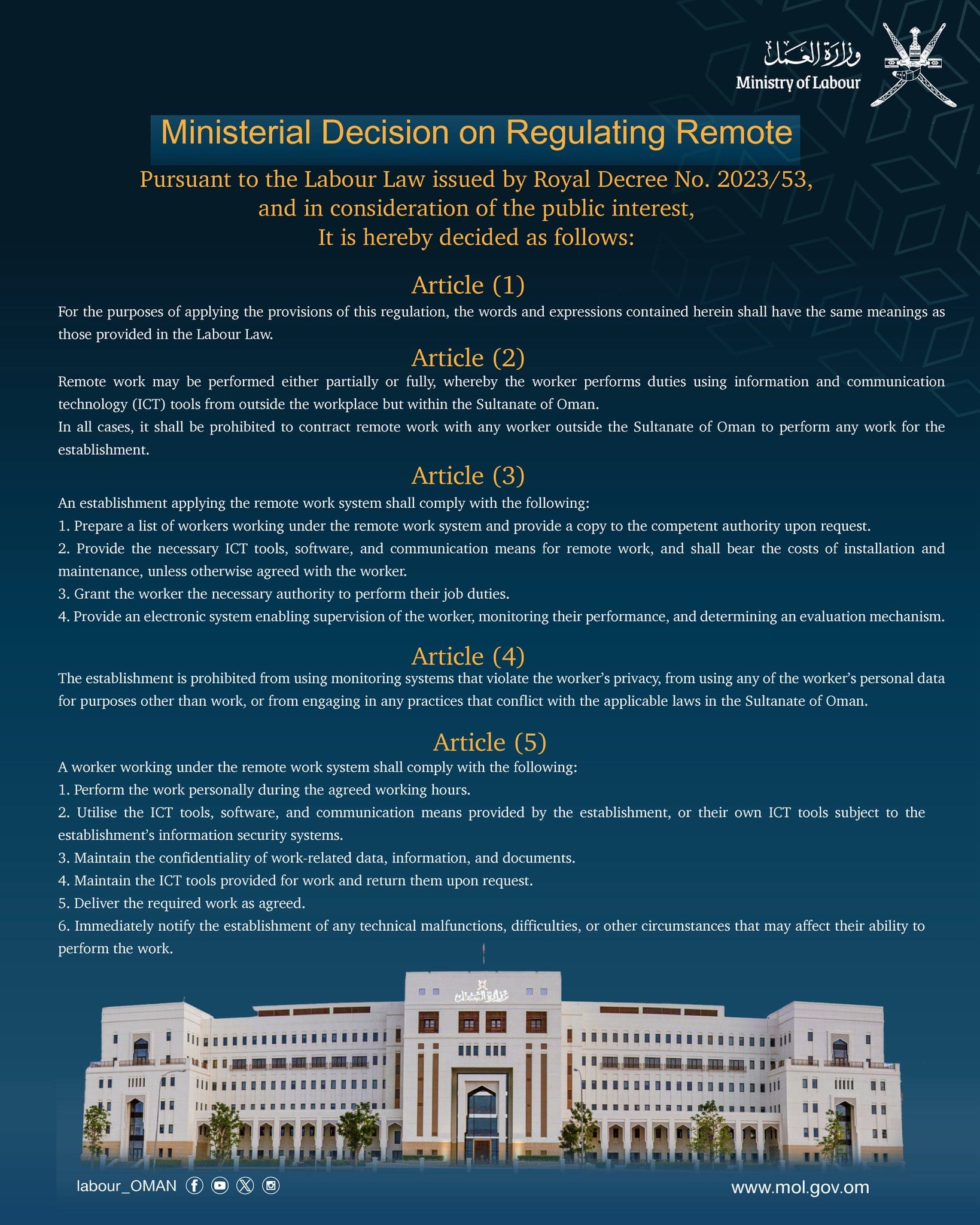
The Ministry of Labour (MoL), Sultanate of Oman, has issued a decision regulating remote work jobs in the private sector.
The regulations are in line with the Labour Law promulgated by Royal Decree No. 53/2023, and aims to modernise the work environment, promote digital transformation, and enhance labour market flexibility while safeguarding the rights of both employers and employees.
Under the new regulations outlined from Article (1) to Article (10), remote work may be undertaken either on a full-time or part-time basis, provided duties are carried out from within Oman using information and communication technology (ICT).
The Labour Ministry also outlined that contracting with workers located outside the sultanate for remote assignments is prohibited.
Employers obligations for remote work
The regulations outlines employers responsibilities when adopting remote work, and these are: - The employers have to provide necessary ICT tools, software, and communication systems, covering installation and maintenance costs unless agreed otherwise.
- They have to establish electronic systems for supervision, monitoring, and performance evaluation.
- They need to maintain a list of remote workers for submission to authorities upon request.
- They must protect employees’ privacy by preventing misuse of personal data and avoiding intrusive monitoring systems.
Employees obligations for remote work
The regulations also underlined remote worker’s responsibilities as under:
- The remote workers must perform their duties personally during agreed working hours.
- The remote workers must use ICT tools provided by the employer or compatible personal devices approved by company systems.
- The remote workers maintain confidentiality of work-related information and protect ICT tools.
- The remote workers must promptly report any technical or operational issues affecting performance.
- The remote workers must return ICT tools when requested and comply with company security standards.
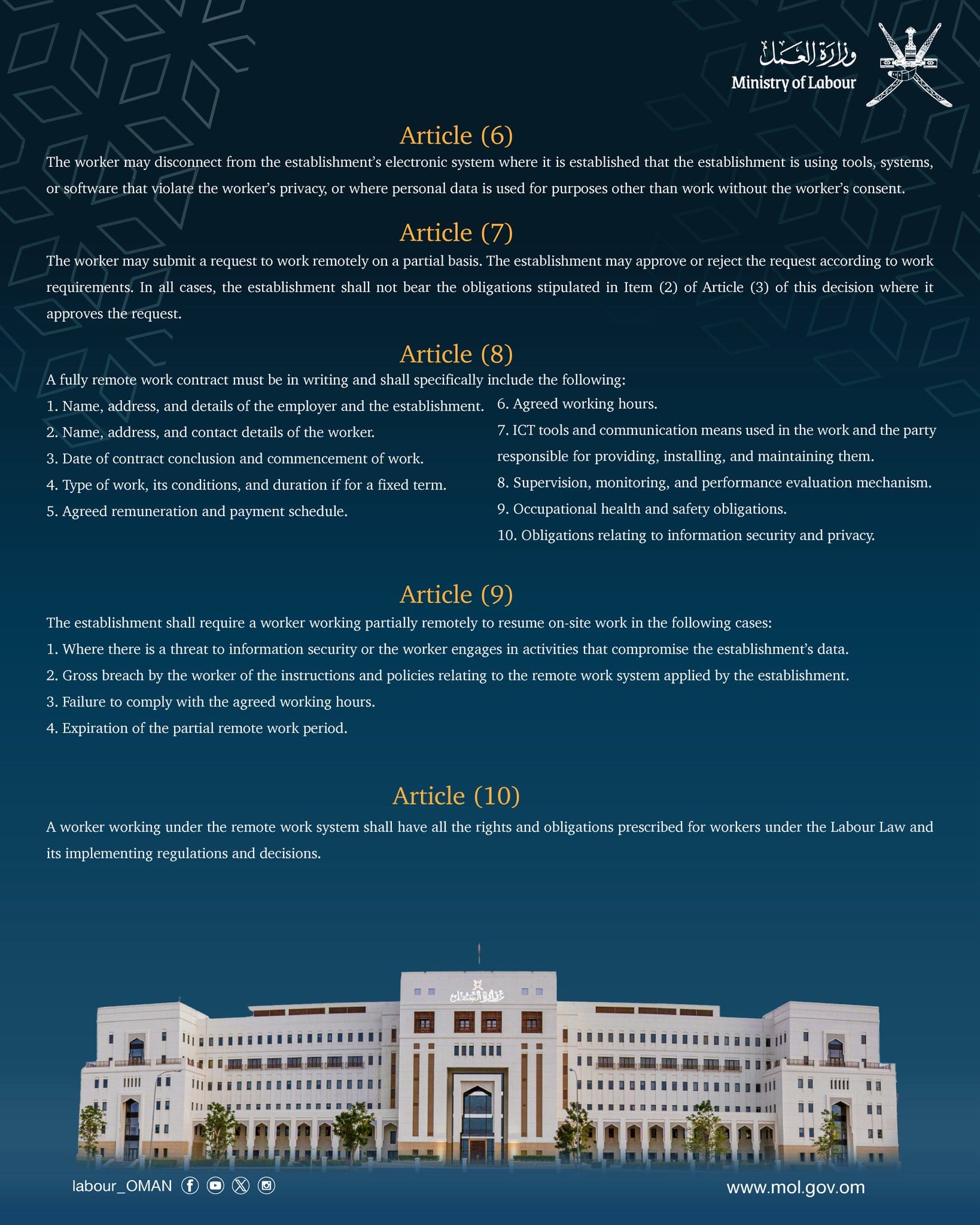
All the employees under remote work contract also have the right to disconnect from systems if work practices infringe on their privacy or misuse personal data.
What must remote work contracts in Oman include?
The regulations also determined the essentials of fully-remote work contracts in Oman, and these are:
- All the remote work contracts must be documented in writing.
- The remote work contracts must mention details of the employer and worker, work type, duration, and remuneration clearly.
- The remote work contracts must clearly define working hours, methods of supervision and evaluation.
- The remote work contracts must define employer and employee’s obligations related to occupational safety, information security, and privacy.
Essentially, the contract should balance clarity on work expectations, employer responsibilities, and worker rights, while safeguarding productivity, security, and privacy.
You may also like:
- Grappling with high turnover in retail? Here’s how learning & skilling can help
- UAE HR firm loses Dh50,000 in cyber scam
- Google cuts 35% of small-team managers in efficiency drive
- Culture, AI Skills, Care or Big Bonuses? What EX in 2025 truly means
- Report finds UAE workers spending extra hours in office to ‘keep up'
The Ministry emphasised that all remote workers continue to enjoy the full rights and obligations guaranteed under the Labour Law and related regulations. The decision is expected to boost efficiency and productivity while reinforcing Oman’s shift towards a digitally enabled and flexible labour market.
Topics
Author
Loading...