






Workforce Planning
AI yet to disrupt jobs at scale, Anthropic study finds; youth hiring slows in exposed roles






The report finds that employees in highly exposed occupations are more likely to be older, female, highly educated, and better paid than workers in roles with little or no AI exposure.
A new report by Anthropic introduces a fresh way to measure how AI is affecting jobs and finds little evidence so far that it has triggered large-scale unemployment.
The study proposes a new metric called “observed exposure,” designed to track how much AI is actually being used in real workplace tasks rather than simply measuring what AI could theoretically do.
By combining theoretical capabilities of large language models with real-world usage data, the researchers attempt to identify which occupations are most likely to face disruption.
The results suggest that while AI tools are capable of performing a wide range of tasks, their real-world adoption remains significantly lower.
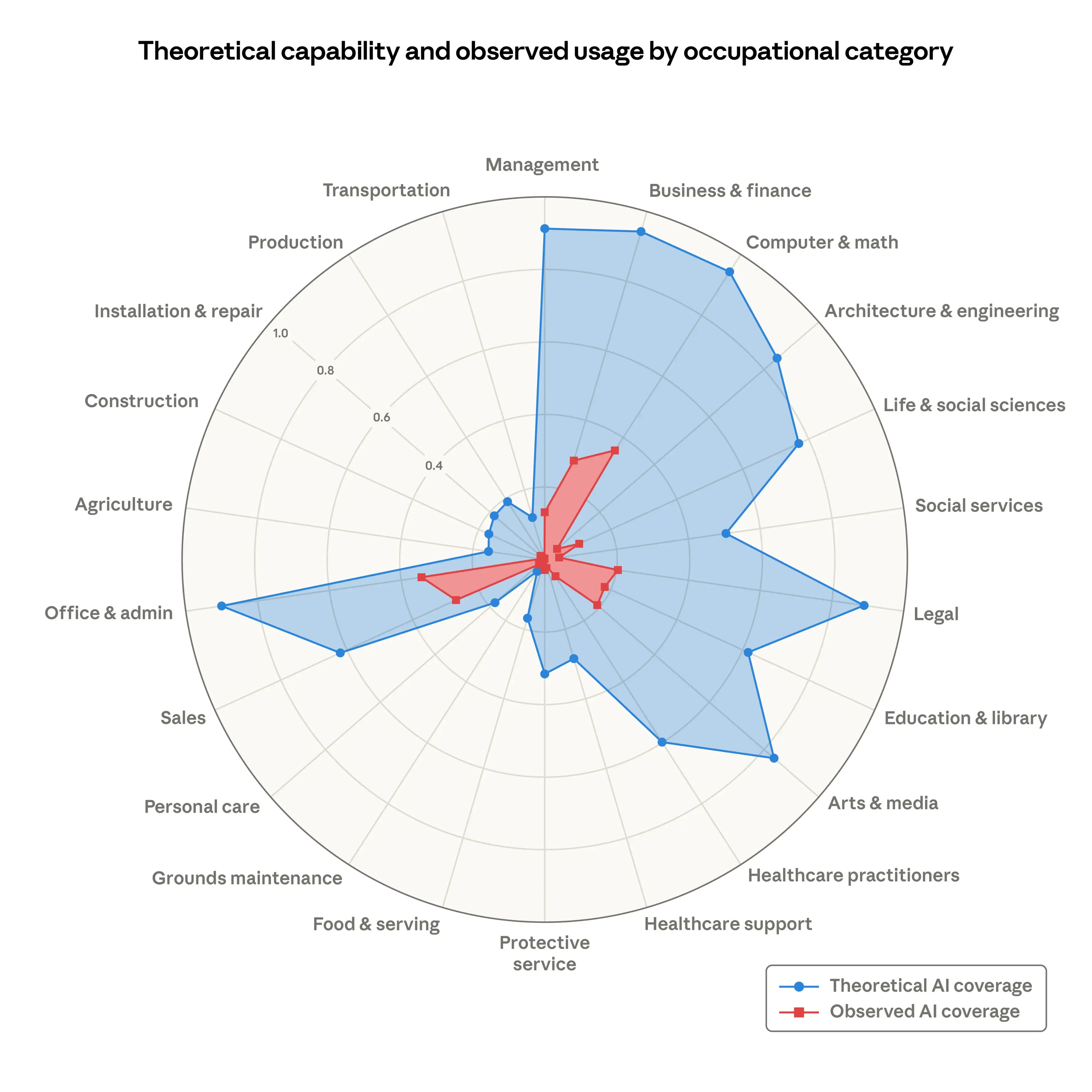
AI adoption far behind theoretical capability
The report finds that AI has not yet reached anything close to its theoretical potential in the workplace. Even in highly digital professions, actual usage of AI tools represents only a fraction of the tasks that could theoretically be automated.
For example, in computer and mathematics occupations, one of the most AI-exposed categories, AI currently covers about 33% of tasks, despite the technology theoretically being capable of assisting with far more.
Across the economy, many jobs remain largely untouched. Around 30% of workers fall into occupations with virtually no measurable AI exposure, including roles such as cooks, bartenders, lifeguards, mechanics, and other hands-on professions where physical tasks dominate.
Programmers, customer service roles among most exposed
Using the new exposure metric, the report identifies several occupations that appear most vulnerable to AI influence. Computer programmers rank highest, with AI already touching about 75% of their tasks, largely due to the growing use of coding assistants and generative AI tools.
Other highly exposed roles include customer service representatives, where AI chatbots and automated support tools are increasingly common, and data entry clerks, whose tasks are particularly suited to automation.
Financial analysts and other knowledge workers also appear among the professions with relatively high exposure levels.
Job growth projections slightly weaker in AI-exposed fields
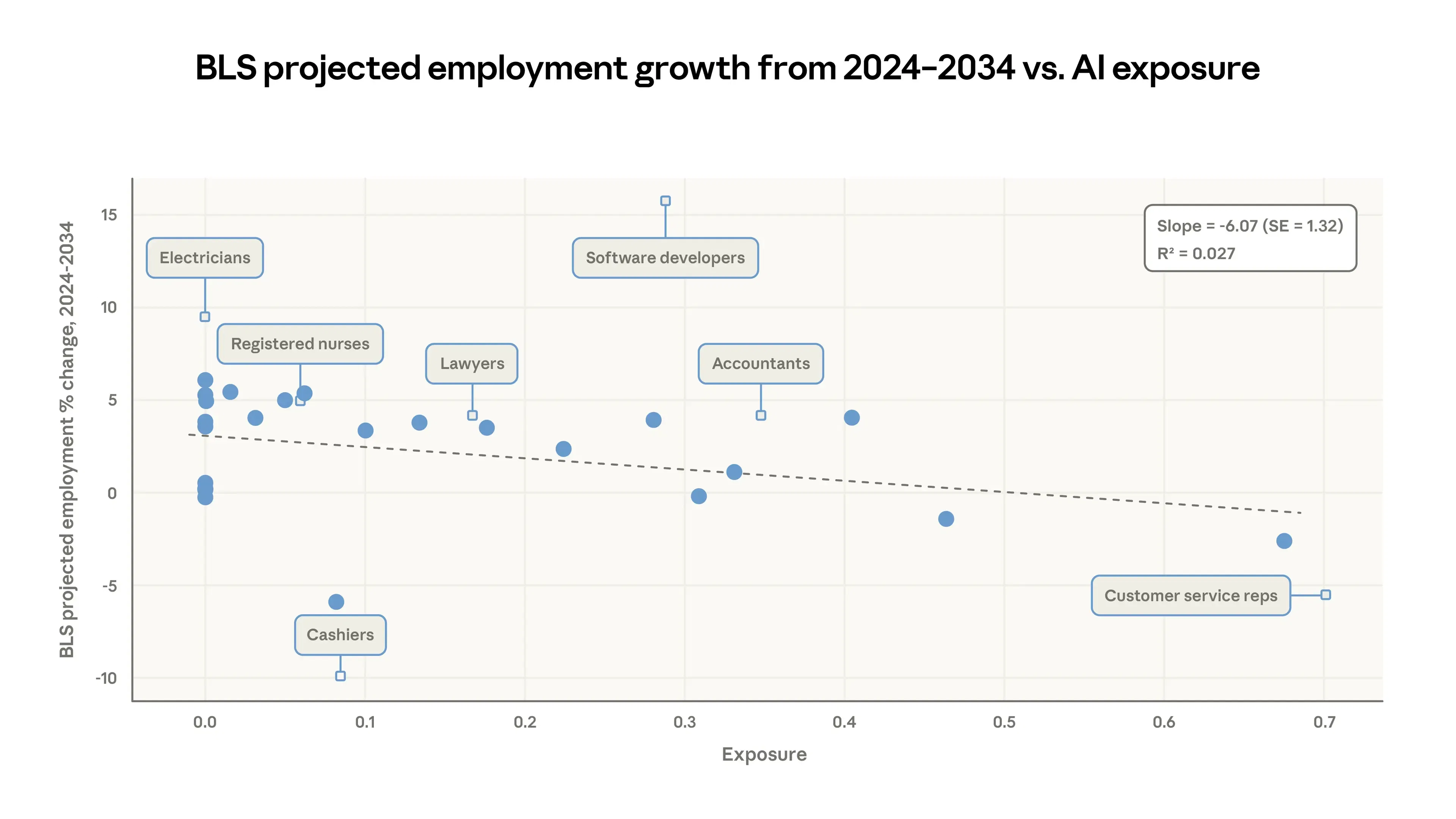
The study also compares AI exposure with employment projections published by the U.S. Bureau of Labor Statistics. It finds that occupations with higher exposure to AI tend to show slightly weaker projected employment growth through 2034.
According to the analysis, every 10-percentage-point increase in AI task coverage is associated with a 0.6 percentage-point decline in projected job growth.
However, researchers caution that the relationship is modest and does not necessarily imply immediate job losses.
Highly exposed workers tend to be educated and higher paid
Interestingly, the workers most exposed to AI are not those traditionally considered vulnerable to automation. The report finds that employees in highly exposed occupations are more likely to be older, female, highly educated, and better paid than workers in roles with little or no AI exposure.
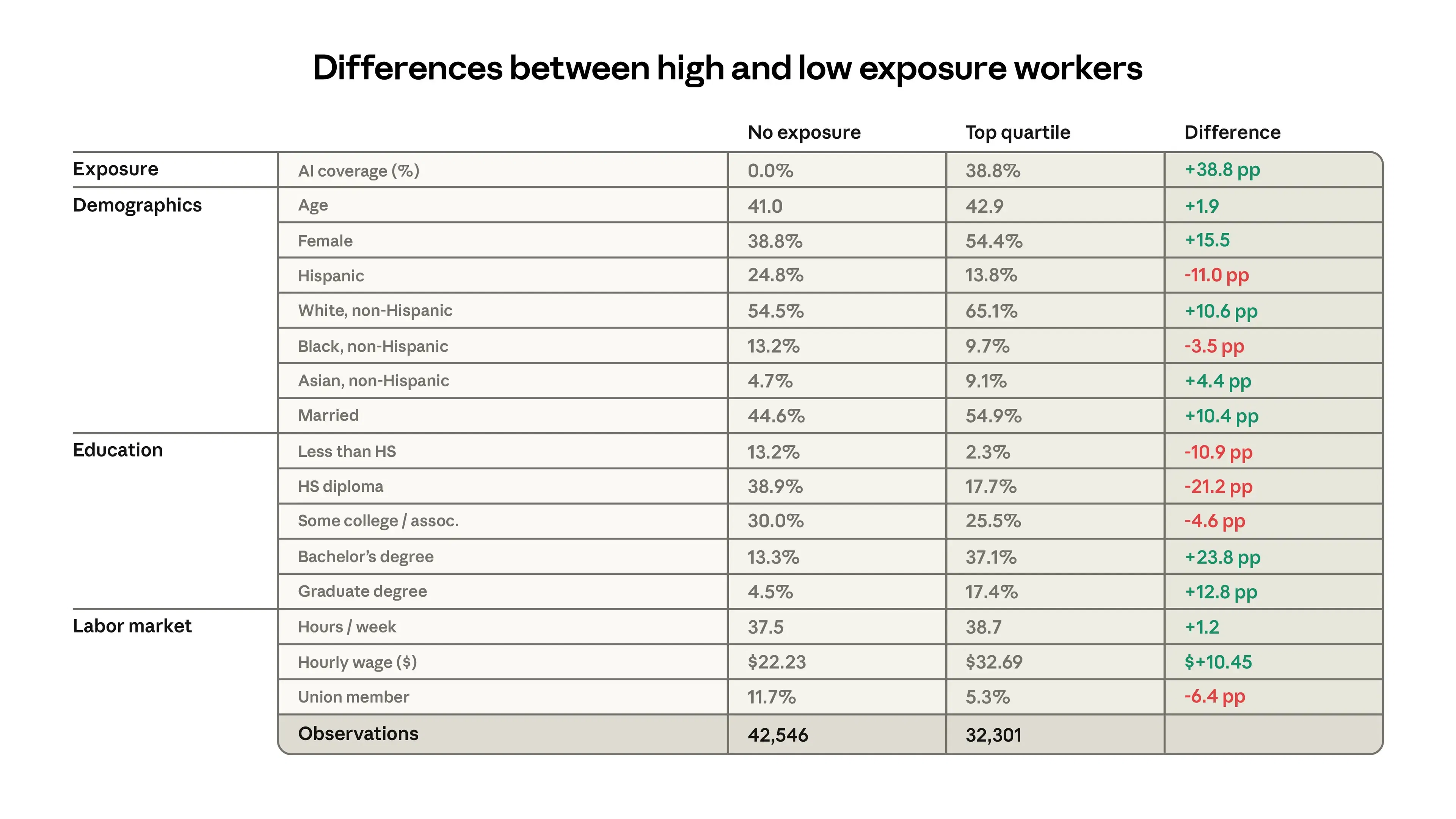
On average, workers in the most exposed occupations earn 47% more than those in low-exposure roles. Graduate degree holders are also far more represented in high-exposure professions, highlighting how AI is increasingly interacting with knowledge-based work.
No clear unemployment impact so far
Despite rising AI adoption since the public launch of generative AI tools such as ChatGPT in late 2022, the report finds no systematic increase in unemployment among workers in the most exposed occupations.
Using employment data from the Current Population Survey, researchers compared unemployment trends between highly exposed workers and those in roles with no AI exposure. The results show that unemployment rates in the two groups have remained broadly similar since 2022.
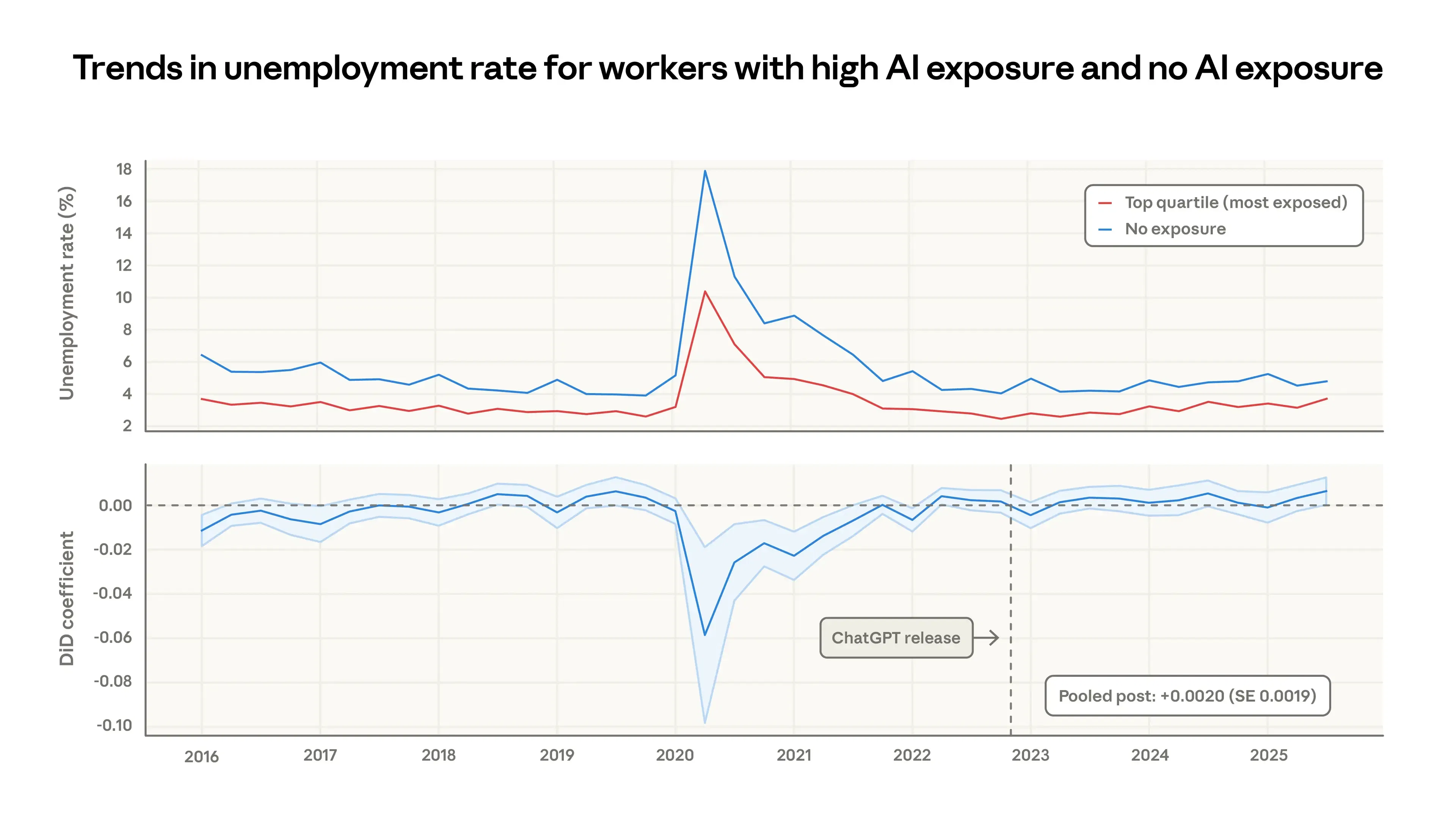
The findings suggest that any labour market impact from AI may be gradual and difficult to detect in aggregate employment statistics, similar to how earlier technological shifts such as the internet unfolded.
Early signals among younger workers
While overall unemployment trends remain stable, the report identifies a potential early signal among younger workers. Hiring rates for workers aged 22 to 25 entering highly exposed occupations appear to have slowed slightly, with job-finding rates dropping by about 14% compared with 2022 levels. The decline appears to reflect slower hiring rather than layoffs.
Researchers caution that the evidence is still tentative and could reflect other factors, including workers pursuing different career paths or returning to education.
AI’s labour impact may unfold gradually
The report argues that major economic shifts driven by AI may resemble past technological changes, where impacts emerged slowly and were difficult to isolate from other economic forces such as business cycles or policy changes.
Rather than expecting sudden job losses, the report suggests that the first signals of disruption may appear through slower hiring, shifting skill demands, and gradual changes in job composition.
For now, however, the data indicates that the AI revolution in the labour market is still in its early stages. “AI is far from reaching its theoretical capability in the workplace,” the report notes, adding that continued monitoring will be essential to understand how the technology ultimately reshapes employment.
Topics
Author
Loading...