






Strategic HR
Qatar amends Civil HR Law; Job-based allowances raised, Paid maternity & Postnatal leave extended to 3 months, Increments up to 150%






Additional incentives include annual performance and supervisory bonuses (up to QAR 120,000/year), accelerated promotions, and special awards for government excellence recipients. Working women receive remote work during the final months of pregnancy, along with core benefits.
The Civil Service and Government Development Bureau (CGB), Doha, has announced Qatar’s latest amendments to its civil human resources law as a major stride toward improving government performance, public service delivery, and employee satisfaction.
The amendments issued under Law No. 25 of 2025 by HH the Amir Sheikh Tamim bin Hamad Al-Thani, updates the 2016 Civil Human Resources Law and are accompanied by newly ratified executive regulations.
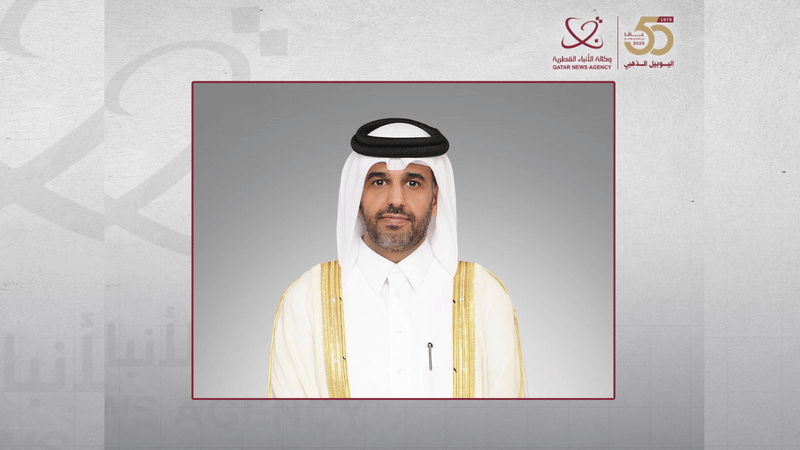
His Excellency Dr. Abdulaziz bin Nasser bin Mubarak Al Khalifa, President of the CGB, said the changes are based on extensive analysis and align with Qatar National Vision 2030. “These reforms aim to modernize public sector work, support innovation, strengthen accountability, and enhance the balance between professional and personal life for government employees,” H.E Al Khalifa stated.
According to the Bureau, the amendments form part of a broader national strategy to build high-performing institutions and a skilled workforce capable of thriving in a knowledge-based economy.
“To strengthen a work environment that attracts talent and ensures continuity, the amendments to certain provisions of the Civil Human Resources Law and its executive regulations include a package of incentives" CGB said.
"Among the most notable are a recruitment and retention allowance for outstanding Qatari employees, and an allowance for holders of specialized professional certifications. The benefits system has also been updated to include overtime and annual leave allowances, aligning with the needs of various job categories and enhancing the competitiveness of the public sector in retaining top talent,” the statement further added.
Key reforms around performance development
The updated law introduces a comprehensive framework built on four strategic pillars to stimulate institutional performance and career growth. Central to this is a merit-based compensation and advancement system, including two new performance evaluation categories: Exceeds Expectations and Exceptional.
The previous ratings of Excellent, Very Good, and Good have been consolidated into Meets Expectations, while Acceptable has been reclassified as Below Expectations.
This restructuring is expected to enhance fairness and transparency in promotions, rewards, and evaluations.
Promotion timelines will now be expedited based on performance, with annual increments standardized to January 1 each year.
Employees may receive up to 150% of the designated grade level as a performance-based increment.
Additional incentives include:
Annual performance bonuses and a supervisory bonus of up to QAR 120,000 per year.
Accelerated promotions or special rewards for recipients of individual or institutional government excellence awards.
Increased in-kind rewards for outstanding employees and departments, from QAR 3,000 to QAR 5,000.
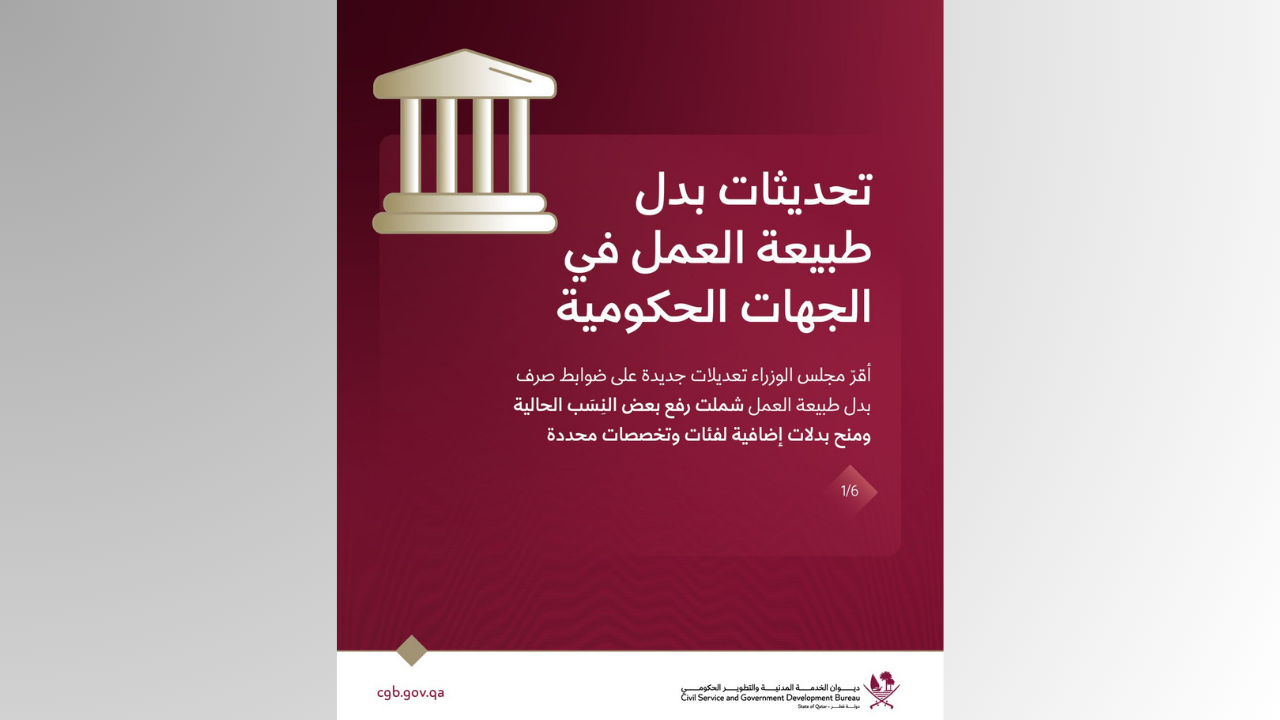
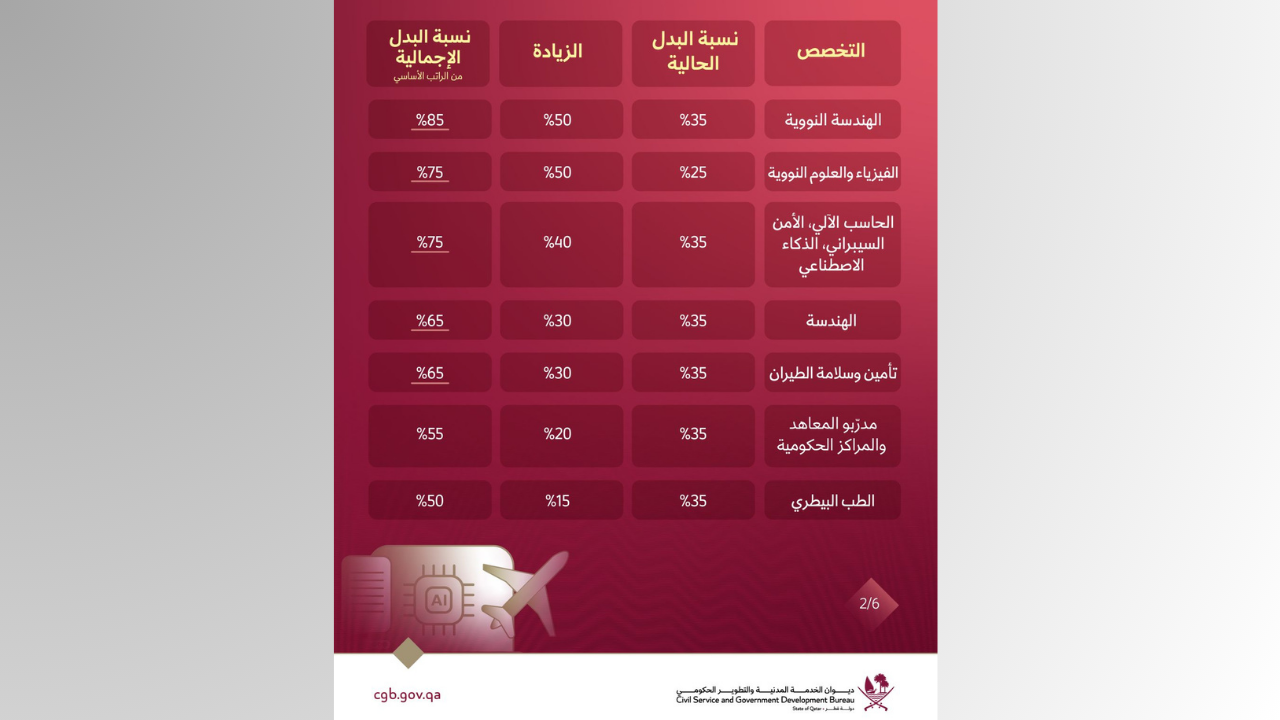
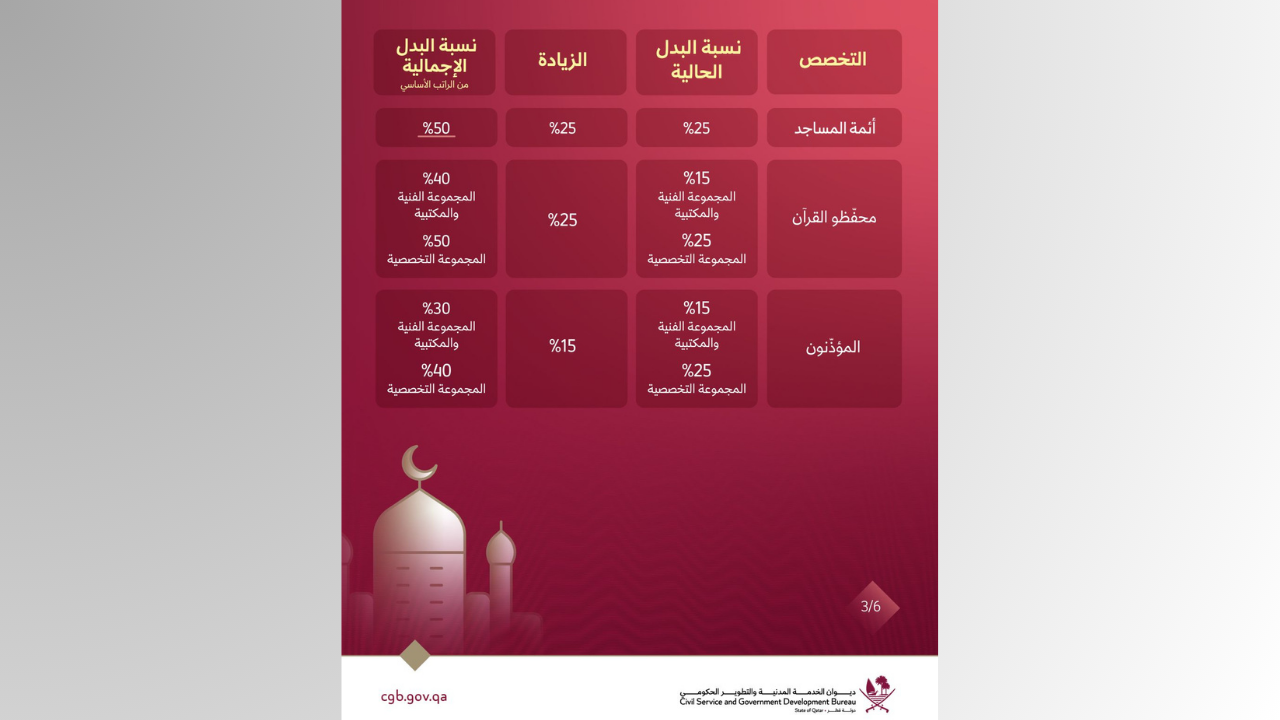
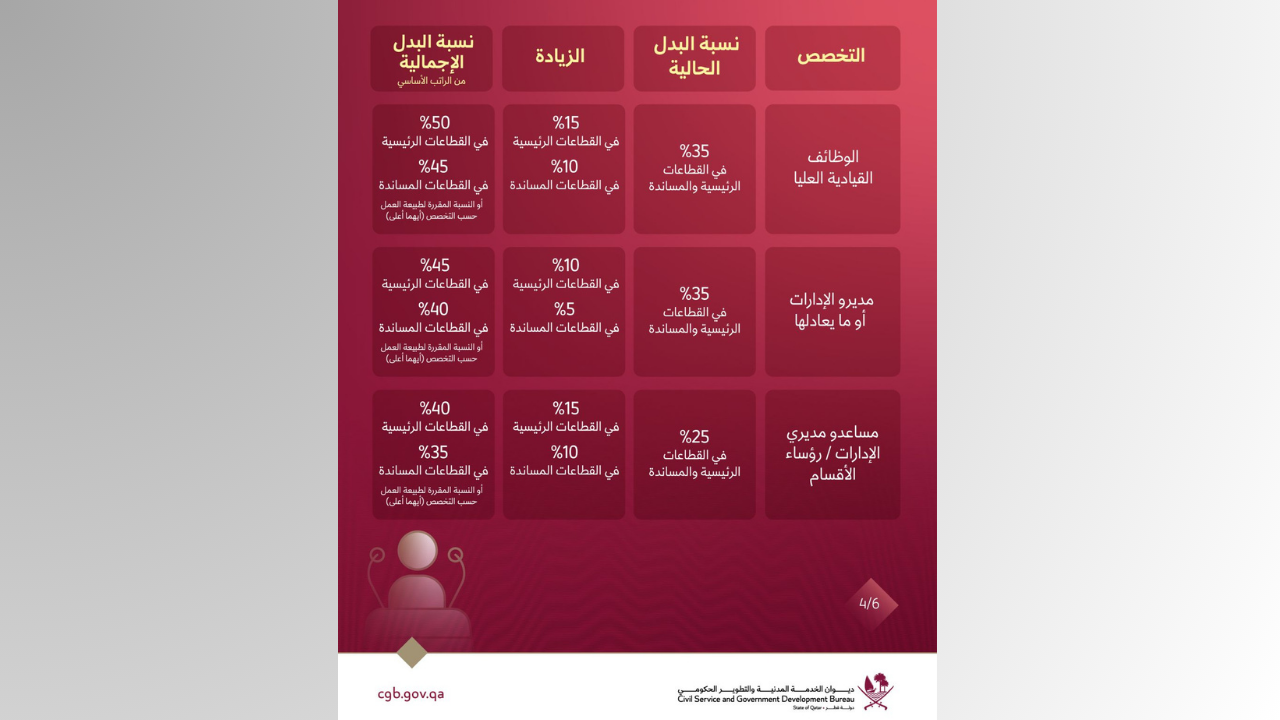
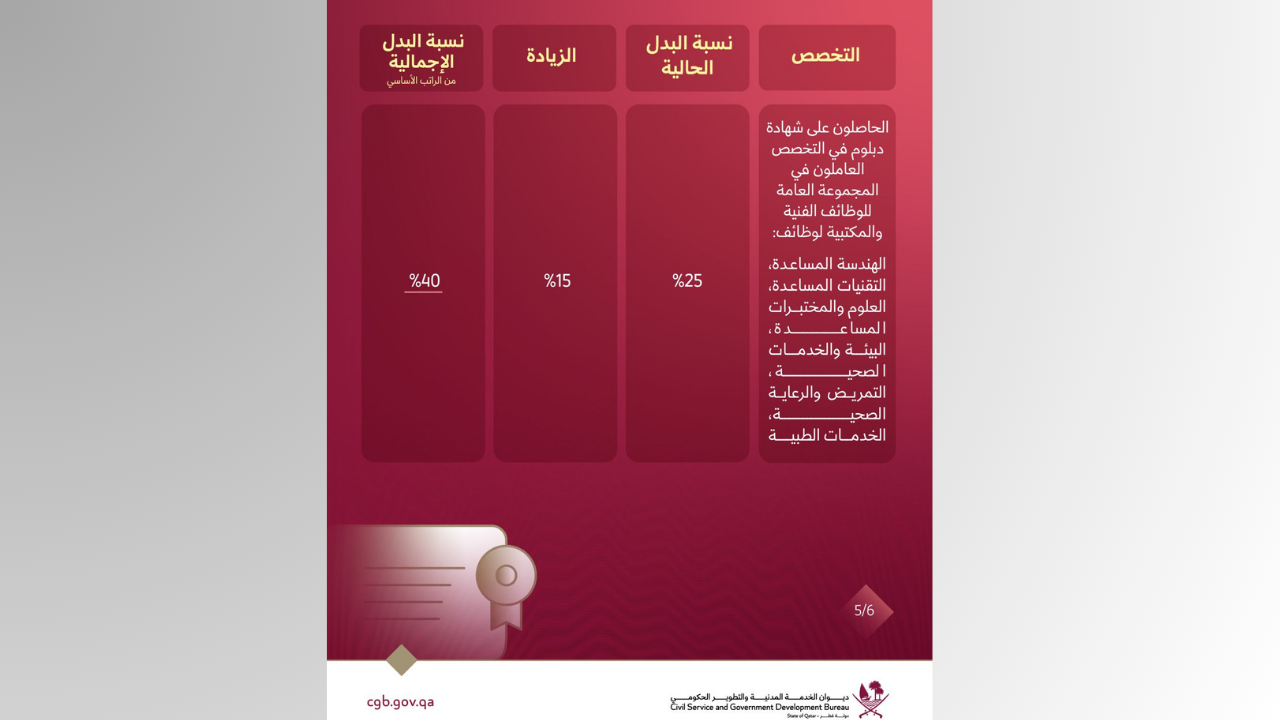
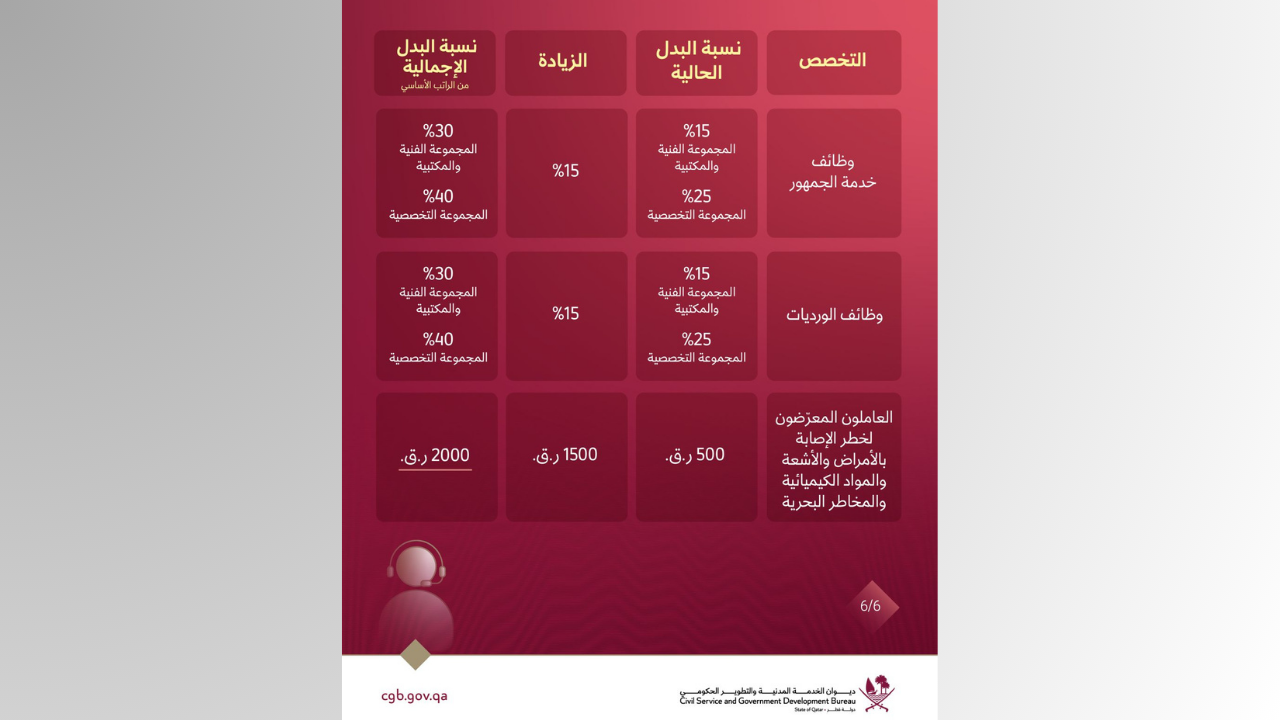
"The Council of Ministers has approved new amendments to the regulations governing the disbursement of the work nature allowance. These include increasing some of the current rates and granting additional allowances to specific categories and specializations," CGB shared.
The revised job-based allowances are:
Reforms for inclusive and extended benefits
Recognizing the importance of national talent retention, the reforms also introduce a recruitment and retention allowance for Qatari employees in specialized and leadership roles, as well as a professional certification allowance for accredited qualification holders.
Overtime compensation has been capped at QAR 10,000 per month for Qataris and QAR 5,000 for non-Qataris, for up to six months annually.
Promotion intervals have been shortened by one year, further encouraging professional advancement.
To modernize recruitment, the government will implement temporary contracts with fixed pay, allow university students to hold part-time government positions, and require agencies to appoint Bureau-nominated candidates within one month, reinforcing structured succession planning.
Strengthening employee well-being with social benefits
The amendments also place strong emphasis on family stability and employee well-being, as CGB has introduced several new benefits including:
- Emergency leave increased to 10 days annually.
- Monthly permission hours expanded to 10 hours (up to 3 hours daily).
- Parental accompaniment for a child’s hospital treatment within Qatar.
- Marital allowance for both Qatari spouses and an annual marriage incentive of QAR 12,000 for each spouse.
- Maternity leave extended to three months with full pay, up to six months for twins or children with disabilities, with flexible start dates from the eighth month of pregnancy.
- Option for remote work during late pregnancy and extended postnatal leave for up to three months at basic salary plus allowances.
Additionally, a single-person housing allowance will be provided to wives not residing with their husbands in government housing in cases of polygamy.
You may also like:
- Women make up 32% of Renewable Energy jobs, Only 19% in leadership roles: Report
- Is your employee wellness data ‘garbage’? Here’s how to know it
- GO Telecom announces 4.5-Day workweek to boost employee well-being & work-life balance
- UAE halts issuing new tourist and work visas for nine countries?
- Mentorship, Talent, and Innovation: Kholoud Zakaria's insights on DP World Egypt’s people-driven transformation
The CGB described the amendments as a “pivotal milestone” in modernizing the legislative framework of public employment. The reforms, it noted, are designed to foster a more transparent, fair, and motivating workplace that meets employee aspirations while elevating the quality of public services.
Topics
Author
Loading...