






Diversity Equity Inclusion
Women make up 32% of Renewable Energy jobs, Only 19% in leadership roles: Report






Big gaps emerge, as private enterprises, which dominate renewables, report only 25% female participation, while NGOs reach nearly 48%, and government or non-commercial institutions hover at 37%.
Women make up 32% of full-time jobs in the renewable energy sector, reveals a new report by the International Renewable Energy Agency (IRENA).
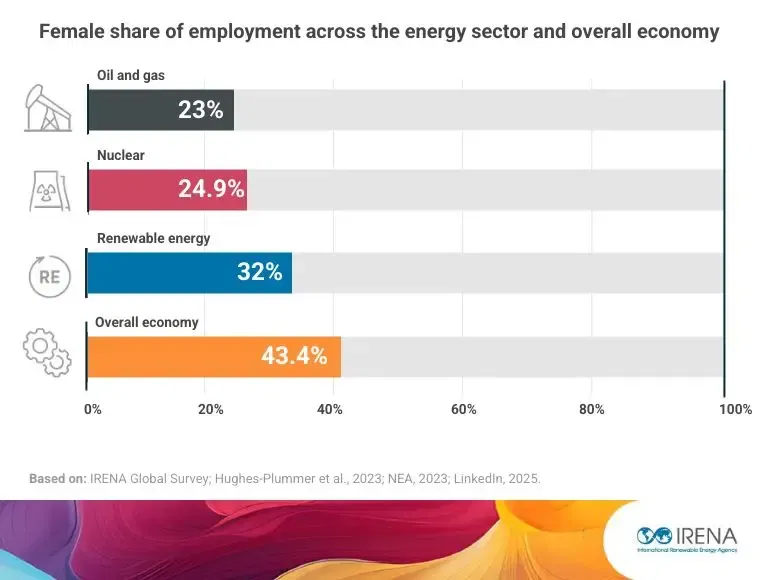
While this is higher than women workforce participation in fossil fuel industries, it hasn’t budged since 2019, indicating that the progress has stalled.
The second edition of Renewable Energy: A Gender Perspective dives deep into women’s participation in the sector, mapping out where they thrive, and where they’re blocked.
The findings are clear: without greater gender equality, the energy transition risks being neither fair nor sustainable, and labour shortages and a lack of diverse perspectives could slow progress for everyone.
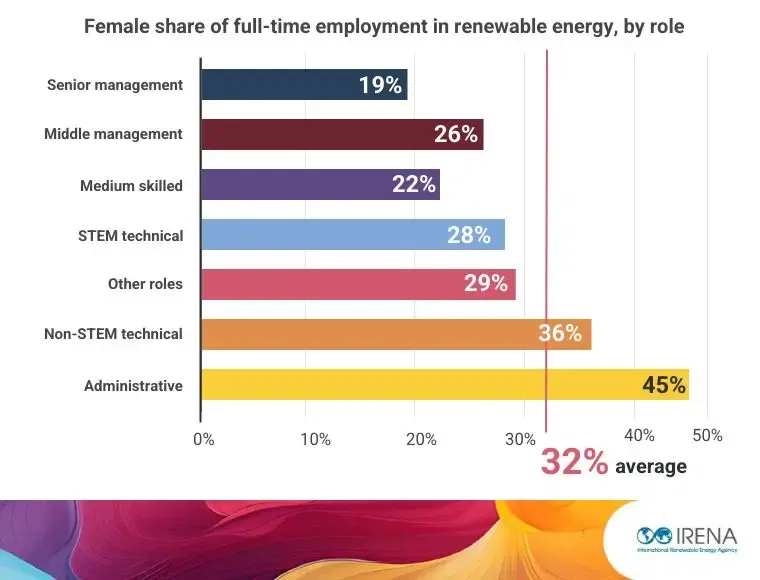
The gaps are stark. Women hold just 19% of senior leadership roles, while dominating administrative positions at 45%.
Their representation drops to 28% in STEM roles and sinks further to 22% in trades, installer, electrician, and construction roles that require technical training or apprenticeships.
Francesco La Camera, Director-General at IRENA, sums it up saying “Advancing gender equality in the renewable energy sector depends on robust data, targeted policy interventions and active collaboration of all stakeholders. Our analysis is the only of its kind to fill this knowledge gap.
Unfortunately, despite performing better than in fossil fuel industries, little progress has been made. The sector still has a lot of work to do. To realise the energy transition’s full potential, women must be recognised as equal partners and leaders in shaping the renewables-based future.”
Barriers persist at every stage of the career journey. Bias, cultural stereotypes, the challenge of balancing work and caregiving, and glass ceilings continue to limit women’s growth.
Yet women are often the primary managers of household energy systems, especially in developing countries, and are heavily involved in community-based energy projects, proving their critical role in achieving universal energy access.
You may also like:
- Is your employee wellness data ‘garbage’? Here’s how to know it
- GO Telecom announces 4.5-Day workweek to boost employee well-being & work-life balance
- UAE halts issuing new tourist and work visas for nine countries?
- Mentorship, Talent, and Innovation: Kholoud Zakaria's insights on DP World Egypt’s people-driven transformation
- L&D Budgets Go Unused? Here’s What’s Really Happening
The report also highlights differences across organisations: private enterprises, which dominate renewables, report only 25% female participation, while NGOs reach nearly 48%, and government or non-commercial institutions hover at 37%.
It also suggest that multi-pronged action can be the solution. Governments need to enforce non-discrimination laws, equal pay, and access to education, while embedding gender equality into climate and energy policies.
Employers must offer flexible work, transparent recruitment and promotion, mentorship programs, and safe, respectful workplaces.
Educational institutions, trade unions, civil society, and international organisations must dismantle stereotypes, expand opportunities, and hold systems accountable.
Author
Loading...