






Economy Policy
UAE MoHESR defines ‘fake work experience’ in new guidelines to strengthen student skills and job readiness







The Ministry also provides practical guidelines to help universities create effective, high-quality programs that build real-world skills.
The Ministry of Higher Education and Scientific Research (MoHESR) has issued guidelines for Governance of Work Experience for Students in Higher Education Institutions (HEIs), including universities and vocational training institutions.
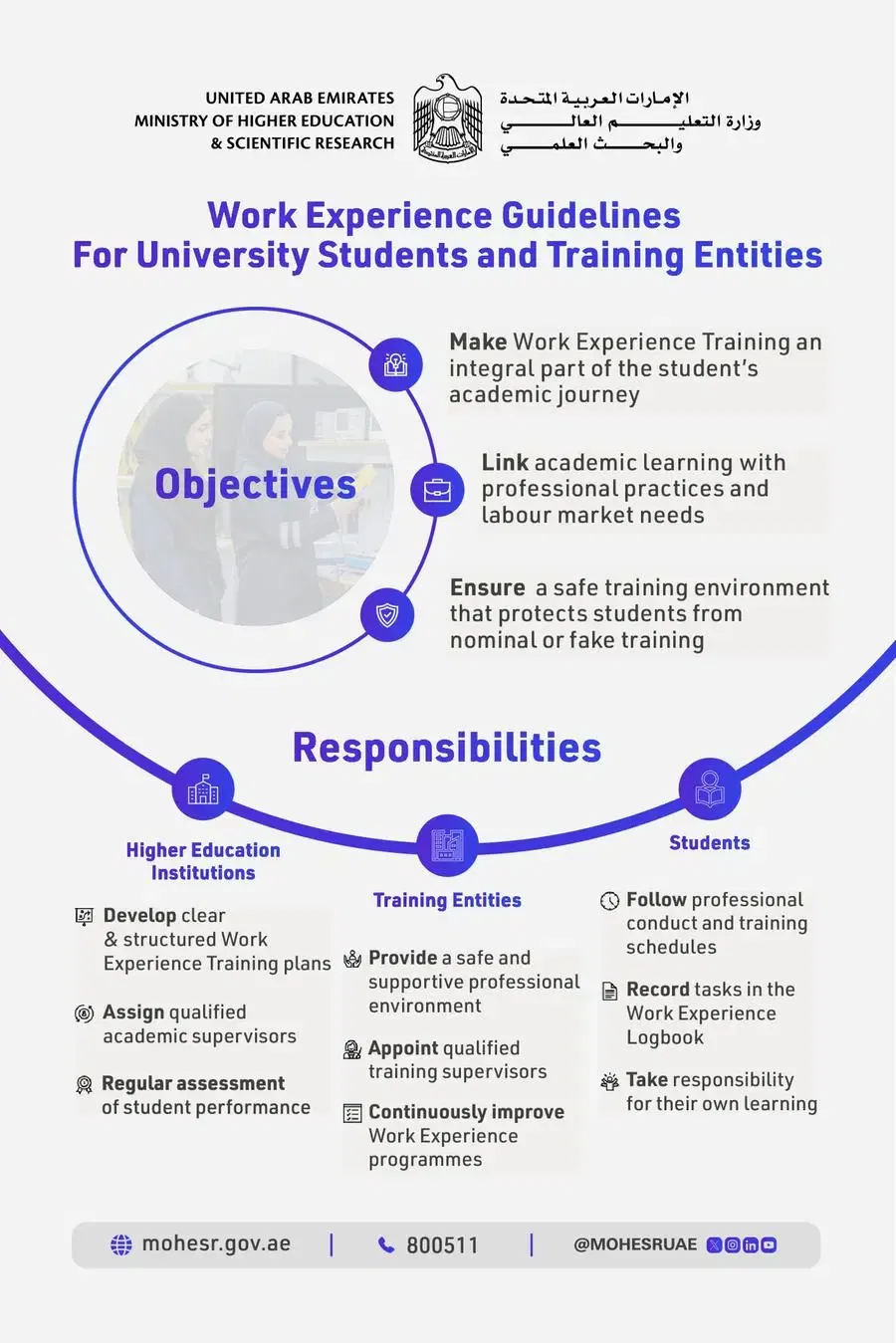
The guidelines make work experience, previously called practical training, a key part of students’ education, helping them connect theory with real-world practices, build job-ready skills, and prevent improper work experience practices.
It serves as a national framework for work experience in higher education, clearly defining the roles of institutions, training providers, and students. And requires HEIs to make clear plans, assign supervisors, and assess student performance.
Work experience providers must offer a safe, supportive, and professional environment with qualified mentors and continuously improve their programs. Students are expected to be professional, attend regularly, and maintain an official record of their work experience.
It states that, “Work Experience (WE) is a crucial link between education and employment. Through structured training:
Students gain exposure to workplace dynamics, industry expectations, and essential soft skills required for long-term career success.
Training providers help develop skills while strengthening ties with the education sector.
Higher education institutions keep programs relevant and aligned with labour market needs.”
The Ministry further defined, “Fake work experience (or nominal training), refers to programs where students are officially enrolled but do not actually receive real or meaningful training. It includes cases where students don’t attend, fail to gain relevant skills, train with unsuitable organisations, or lack proper supervision. Such practices are considered a breach under Ministerial Resolution No. (173) of 2025.”
Commenting on the roll out of the guide, Her Excellency Taif Mohamed Alamiri, Acting Assistant Undersecretary for the Higher Education Regulation and Governance Sector, said, “We ensured the guide offers a clear, practical framework for all stakeholders involved in students’ work experience, aligned with the highest standards of quality and governance. It helps HEIs design more effective programmes, offers work experience providers a framework for collaboration with higher education institutions and gives students hands-on experience to prepare them for the labour market.”
Her Excellency Alamiri added, “The guide reflects MoHESR’s commitment to global best practices in educational governance. Its implementation will be monitored through field visits and ongoing evaluation in cooperation with our local and federal partners, to ensure compliance with the approved criteria. As work experience bridges education and employment, ensuring its quality is a national priority and an investment in the future.”
You may also like:
- Women make up 32% of Renewable Energy jobs, Only 19% in leadership roles: Report
- Is your employee wellness data ‘garbage’? Here’s how to know it
- GO Telecom announces 4.5-Day workweek to boost employee well-being & work-life balance
- UAE halts issuing new tourist and work visas for nine countries?
- Mentorship, Talent, and Innovation: Kholoud Zakaria's insights on DP World Egypt’s people-driven transformation
The Ministry monitors work experience programs through field checks and unannounced visits to universities and training providers, working with institutions like the Ministry of Human Resources and Emiratisation (MoHRE). This ensures standards are met, prevents improper practices, and supports continuous improvement.
MoHESR, together with MoHRE, recently launched a digital project to verify the academic qualifications of private sector workers. The initiative not only ensures accurate verification but also supports the UAE’s digital transformation goals by improving government processes.
Author
Loading...