






Strategic HR
UAE announces reduced and flexible work hours for Ramadan across public and private sectors



 ||
||


FAHR also confirmed that federal entities may continue to implement approved flexible working models during Ramadan, subject to established rules, some entities may permit up to 70% of employees to work remotely on Fridays
The United Arab Emirates has rolled out reduced working hours and expanded flexible work options for employees during the Holy Month of Ramadan, as authorities move to balance workplace productivity with employee well-being.
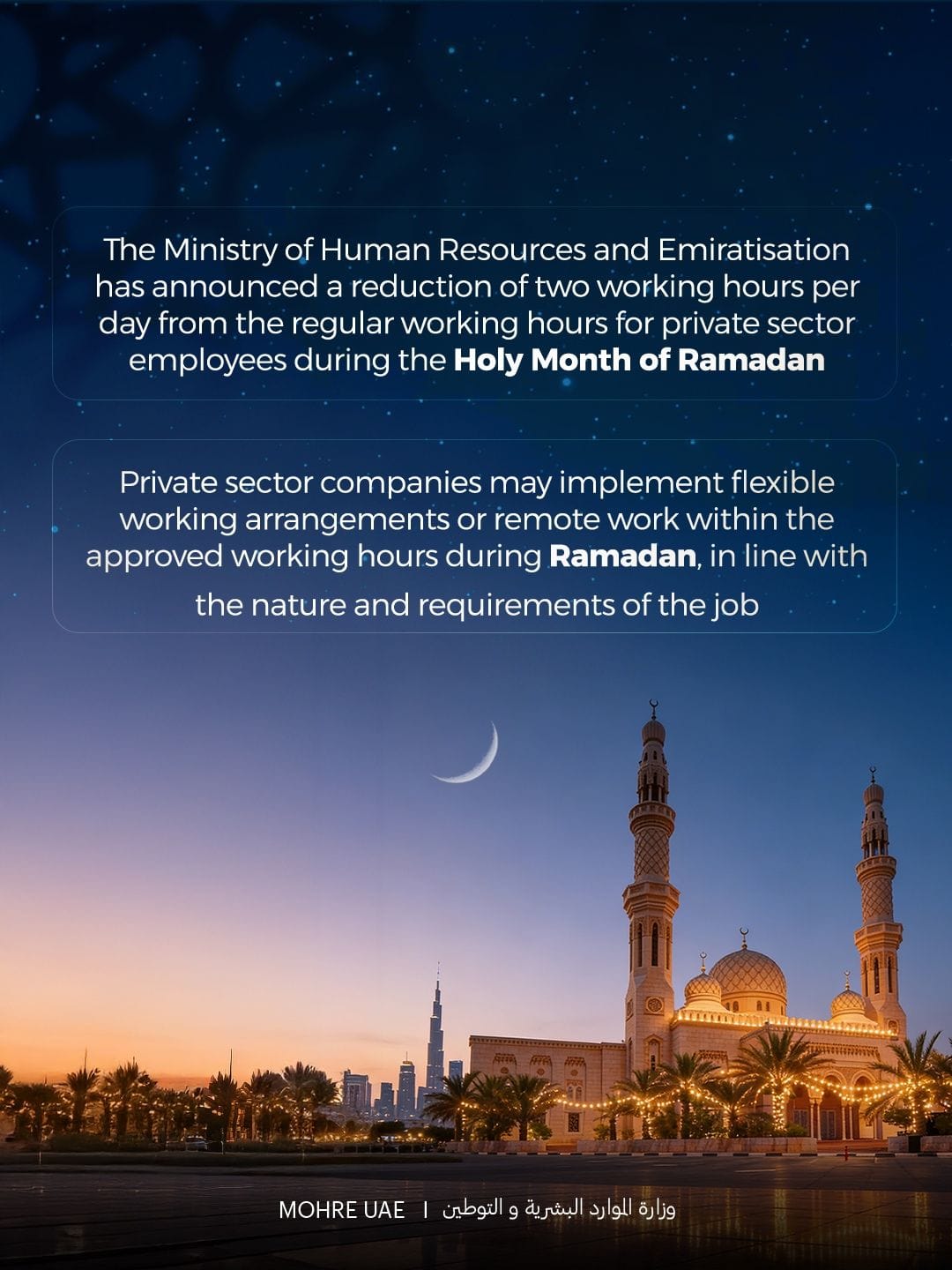
The Ministry of Human Resources and Emiratisation (MoHRE) confirmed that private sector employees will see their regular working hours cut by two hours per day throughout Ramadan. The move applies to all private sector establishments in the country.
“The Ministry of Human Resources and Emiratisation has announced a reduction of two hours per day from the regular working hours for private sector employees during the Holy Month of Ramadan,” the Ministry said.
In addition to the reduction, companies have been given the green light to introduce flexible schedules or remote working arrangements, provided these remain within the approved daily working hours and align with operational requirements.
Private sector: shorter days, flexible options
Under the directive, employers in the private sector have been instructed to limit employees’ working hours to six hours per day, with a weekly cap of 30 hours during Ramadan.
MoHRE said the decision is being implemented in line with the executive regulations of Federal Decree-Law No. 33 of 2021 on the Regulation of Employment Relationships and its amendments.
While the rule standardises shorter hours, businesses retain discretion to structure shifts and schedules in ways that support continuity and customer needs.
Federal government: fixed timings with remote flexibility
Separately, the Federal Authority for Government Human Resources (FAHR) issued a circular setting official working hours for federal ministries and entities during Ramadan 2026 (1447 AH).
According to the circular:
Monday to Thursday: 9:00 a.m. to 2:30 p.m.
Friday: 9:00 a.m. to 12:00 p.m.
Exceptions will apply for roles whose job nature requires different schedules.
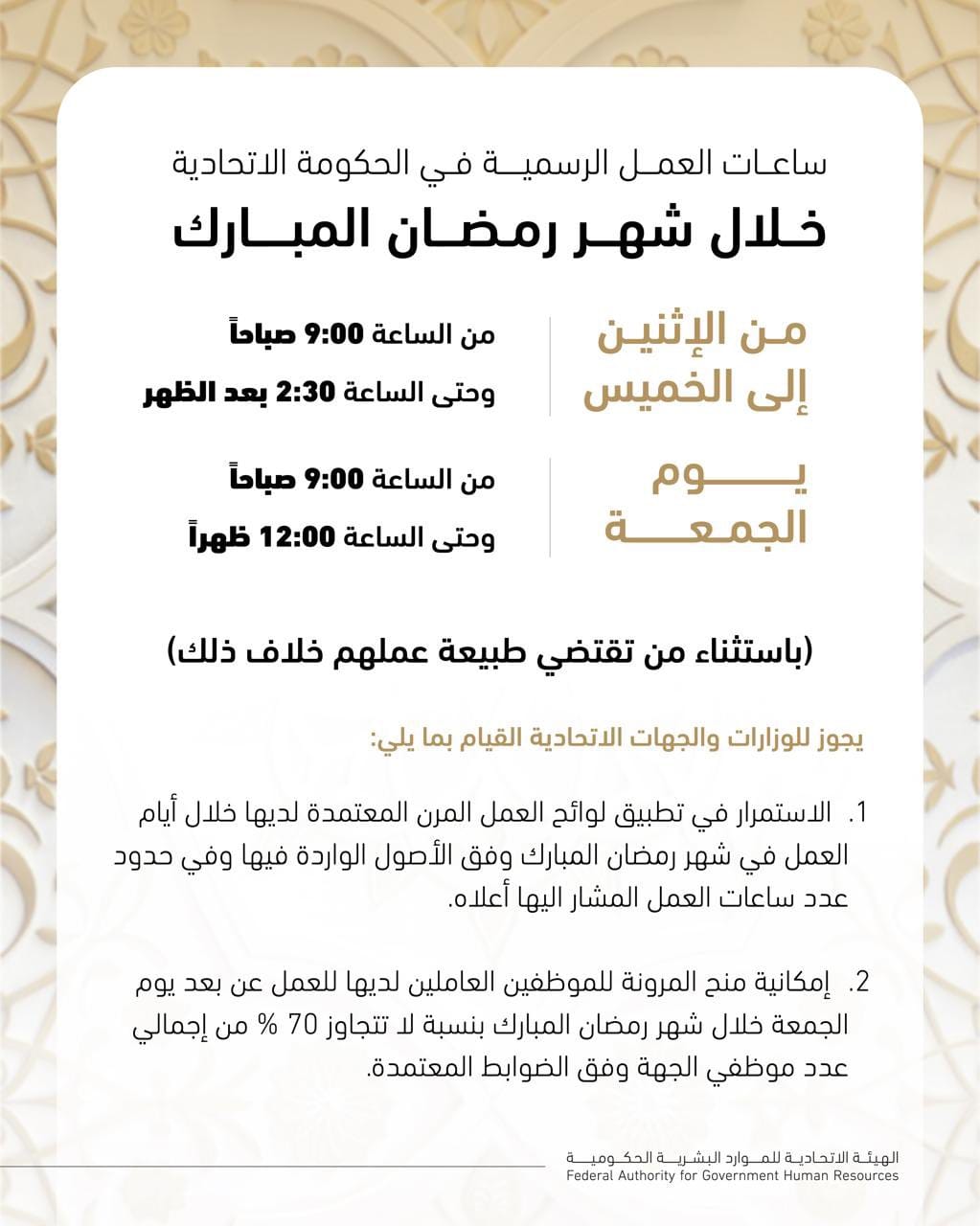
FAHR also confirmed that federal entities may continue to implement approved flexible working models during Ramadan, subject to established rules. Notably, government entities may permit up to 70% of employees to work remotely on Fridays, signalling continued institutional support for hybrid work.
Balancing productivity and wellbeing
The coordinated announcements reinforce the UAE’s now-established Ramadan workplace framework, which blends reduced hours with operational flexibility. For employers, the emphasis remains on maintaining service levels while accommodating the spiritual and physical demands of the holy month.
Extending Ramadan greetings, FAHR conveyed its congratulations to the UAE leadership, government, residents, and the wider world, expressing hopes that the holy month returns with continued prosperity and blessings. The policy underscores the UAE’s evolving approach to workforce regulation, that increasingly combines statutory protections with flexible work models, reflecting broader shifts in how work is organised across the region.
Author
Loading...