






Economy Policy
Kuwait introduces new mechanism to regulate private school working hours







The new framework specifies a five-day workweek with seven working hours per day. It also allows private schools the flexibility to reduce daily working hours to a minimum of six, provided the total weekly working time stays within the maximum limits set by labor law.
Kuwait’s Public Authority for Manpower (PAM) has approved a new mechanism that caps the working hours of private school employees at seven actual hours per day, in a commitment to streamlining working conditions across the private education sector,
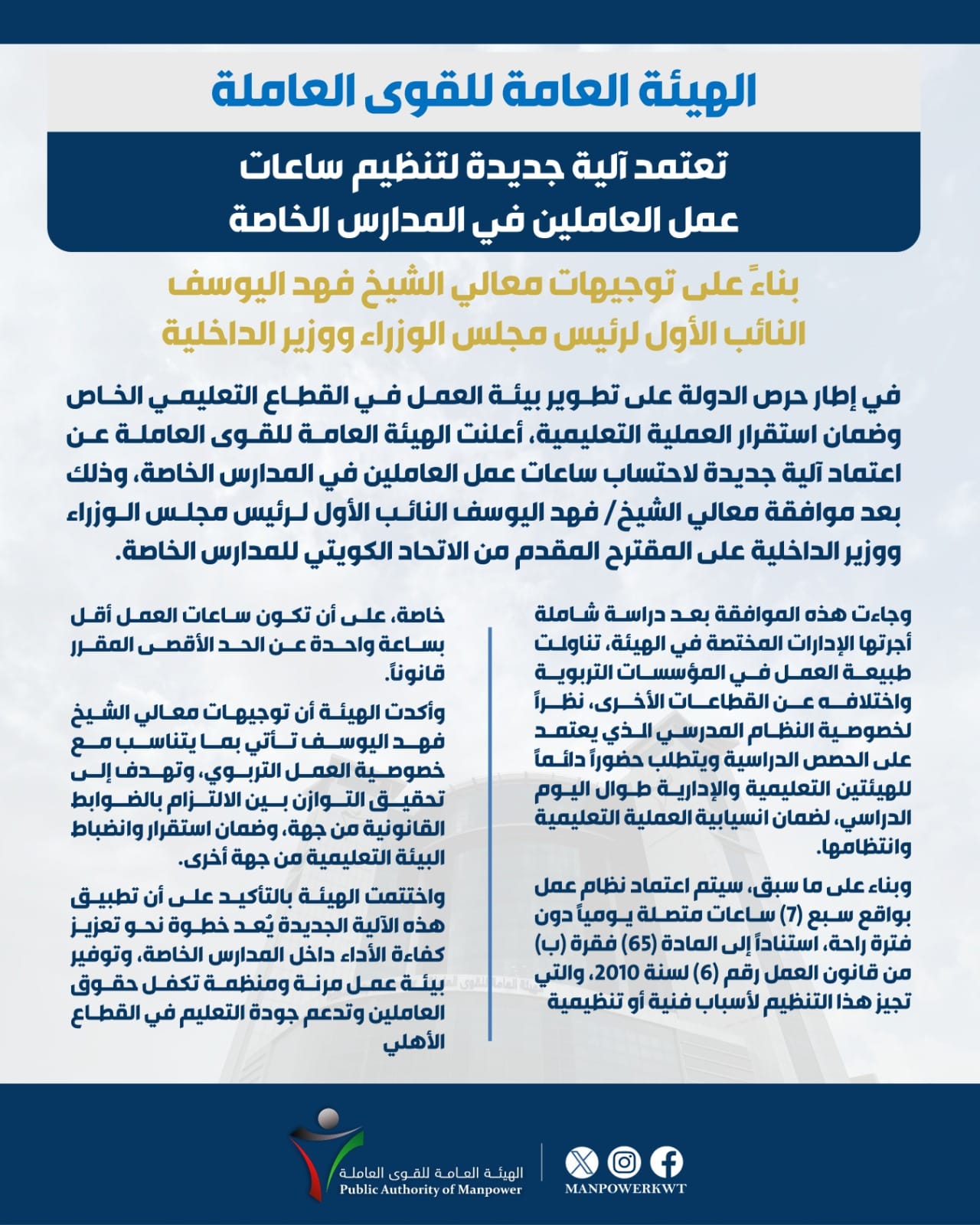
The new mechanism announced on Wednesday, builds on recommendations from the Private Schools Union of Kuwait (PSUK) and has been formally endorsed by First Deputy Prime Minister and Minister of Interior Sheikh Fahad Al-Yusuf Al-Sabah.
PAM noted that the new system was finalized after an extensive study that took into account the unique nature of educational institutions, where both teaching and administrative teams are required to be present continuously to maintain the flow of the school day.
As described in Article 65 of the Labor Law, the mechanism sets the workday at seven consecutive hours without a break, a format permitted under Article 65(b) of Labor Law No. 6 of 2010 for technical and organizational reasons.
According to PAM, the update is designed to create a more efficient, well-regulated work environment that protects employees’ rights while supporting the overall quality of private education in Kuwait.
The new framework specifies a five-day workweek with seven working hours per day. It also allows private schools the flexibility to reduce daily working hours to a minimum of six, provided the total weekly working time stays within the maximum limits set by labor law. The regulation also ensures that employees receive a minimum one-hour daily rest period during working hours, reinforcing compliance with labor standards and supporting a healthier, more balanced work environment.
This latest step comes on the heels of a separate set of guidelines introduced by the Ministry of Education in September 2024, when the ministry rolled out flexible working hours as well as official hours for educational and administrative staff across both public and private schools.
Under those guidelines, school administrations, particularly principals, assistant principals, and department heads, are required to closely monitor working hours. The Ministry also made it mandatory for at least one senior administrator to remain on campus throughout student hours. Any breach is subject to legal review and escalation to the Undersecretary of the Ministry.
Teachers and administrative employees are permitted off-duty hours, provided their total working time does not drop below five hours, in line with Law 21/2015 pertaining to children’s rights. Supervisors are tasked with ensuring this flexibility does not disrupt the academic rhythm of the school day.
The Ministry also outlined detailed start-and-end times across the different education stages, from kindergarten to secondary across public, private, religious, and special education schools. Additionally, Mentor working hours were set from 7:00 AM to 2:00 PM under Ministerial Resolution 171/2023.
Attendance regulations have tightened as well. Teaching and administrative staff are now required to confirm their presence using the fingerprint system within a specific 60-minute window. Those who fail to do so without approved permission will be marked absent, and the missed time will count toward monthly delay calculations under Civil Service Council Resolution No. 6 of 2024.
You may also like:
- 51% of AI learners in Saudi are women: SDAIA report
- Ajman Executive Council approves new HR laws; Introduces flexible working hours for certain employees
- Saudi Arabia to support working women in the private sector with up to 50% childcare coverage
- A Global Leader’s Playbook: Kazunori Fukuda on building a ‘Third Culture’ to power digital transformation
- 45,000 new jobs for women in Arab by 2026; ‘care economy’ and men sharing unpaid domestic work become a must: Dr. Moez Doraid
Together, these changes signal a broader push across Kuwait’s education ecosystem to standardize working hours, strengthen accountability, and support a more stable and efficient learning environment, both for educators and the students they serve.
Author
Loading...